
This is the midday roundup for October 29, 2026. The morning was dominated by Google's three-pronged offensive across models, developer tools, and consumer features; midday brings new releases from the open-model camp alongside numbers from AI semiconductors and earnings reports.
Qwen4 Heads Toward a 1M-Token Context — Qwen4-max Possibly on November 1
Reddit's LocalLLaMA community reported that Alibaba's Qwen4 series will support a **1M-token context window**. The source is a pull request in Qwen's official CLI, qwen-code, where the detail could be read in the model listing.
According to the same report, Qwen4-27B is expected to be announced at the Apsara Conference in the Netherlands on October 30. The flagship Qwen4-max displayed a date of November 1, though the report adds a note of caution: "some spots say October 1, so it could be a placeholder."
Demand for long-document processing runs high among local LLM users, and if the 1M-token support is real, feeding an entire repository or a book-length document straight into the model becomes a practical workflow. We'll be waiting for the official announcement.
Liquid AI's LFM3-Omni-2B — Sees, Hears, and Speaks at 2.2B, Runs on a Smartphone
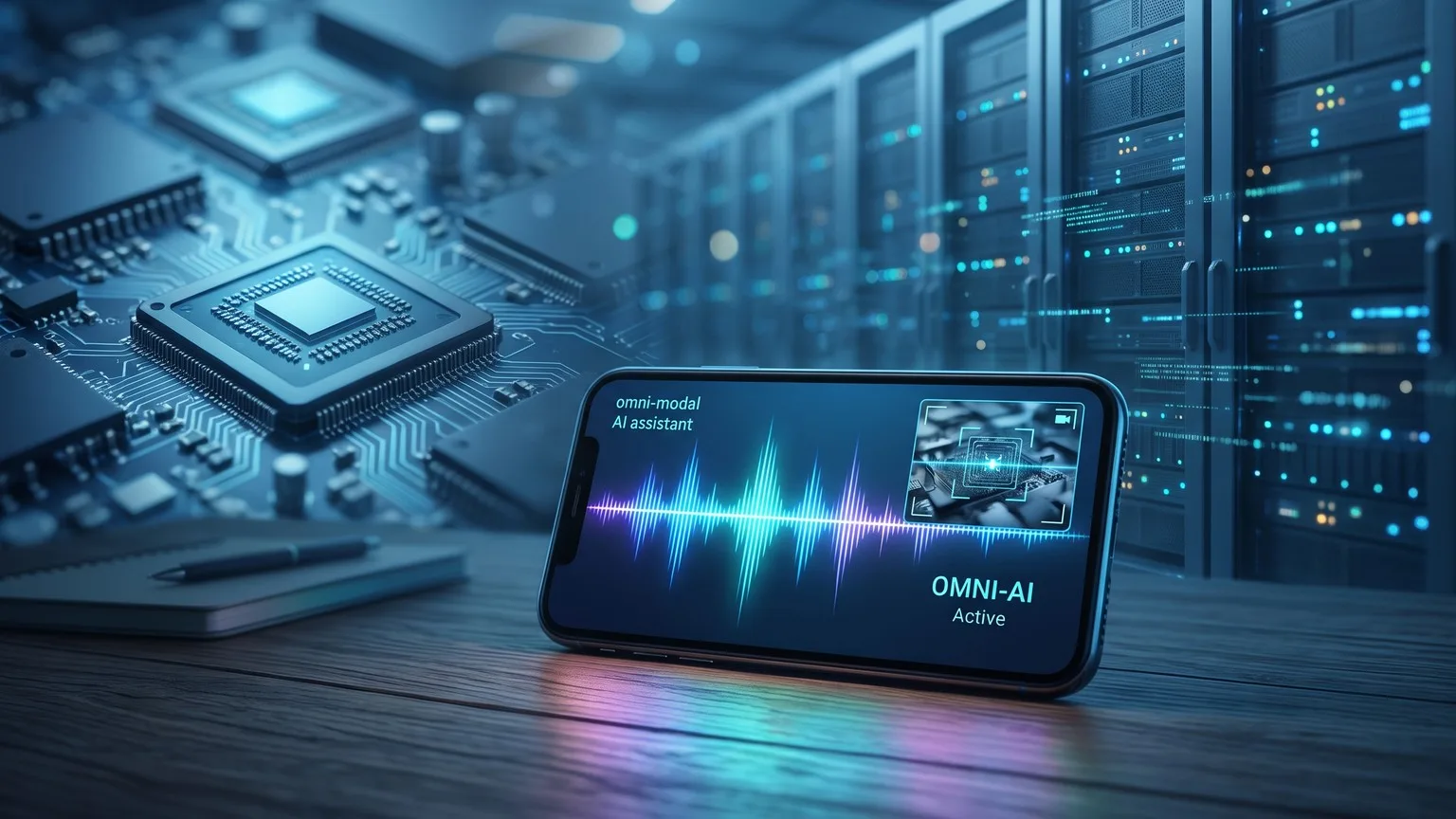
Liquid AI has released **LFM3-Omni-2B**, the first omni-modal model in the LFM3 family, on Hugging Face. It understands text, images, video, and audio as input, and responds in both text and speech. The design replaces what used to be separate components — ASR (speech recognition), a vision-language model, an LLM, and TTS (speech synthesis) — with a single end-to-end model.
What stands out is the size. At 2.17B total parameters, it is built to run on edge devices such as smartphones and laptops. Context length is 32K tokens; text covers 16 languages including Japanese, and speech supports 19 languages and locales. For video, it samples frames at 2fps while simultaneously "listening" to the audio track, so it can answer questions that reference both the visuals and their sound. It ships in BF16 for GPUs (SGLang, Transformers) plus GGUF weights that run on CPU (llama.cpp, with real-time voice server support).
On benchmarks, it scores 70.09 on Daily-Omni for video-plus-audio understanding, beating Qwen2.5-Omni 7B (61.32) and Gemma 4 E2B — results that hardly seem to come from 2.2B parameters. It does not support reasoning, but a fine-tuning notebook was released at the same time, signaling that domain-specific customization is in scope. Whereas NVIDIA's Nemotron 3.5 Transcribe, covered this morning, specializes in transcribing recorded audio, this model takes the route of handling speech input and output as dialogue within a single model. The cost of building voice assistants that run on edge devices looks set to drop yet another notch.
The AI Semiconductor "Megacycle" — Samsung Raises Capex 60%, Advantest Hikes Its Forecast
Samsung Electronics said it plans to raise its 2026 capital expenditure to **84.4 trillion won (about $63 billion)**, an increase of roughly 60%. Relentless demand for AI infrastructure has been pushing memory prices up, and its semiconductor division's operating profit for the July–September quarter surged 15-fold year over year. Even so, with investor expectations running so high, profit fell short of market forecasts. Amid ongoing competition with SK hynix and Micron, Samsung is moving fast to expand supply capacity.
Japanese players are getting a tailwind too. Advantest, a major semiconductor test equipment maker, revised its full-year fiscal 2026 forecast upward to roughly ¥1.863 trillion in revenue, driven by semiconductor demand from the AI boom. The CEO described the AI semiconductor market as being in a "**megacycle phase**," and also voiced expectations for CPUs and optoelectronic convergence.
Startups are active as well. Korean AI chipmaker **FuriosaAI** raised $620 million in a Series D round, quadrupling its valuation to $2.9 billion. US-based Infinitum Partners led the round, with a Korean growth fund contributing $280 million. As a challenger to NVIDIA, it is shoring up its war chest.
Microsoft Discloses Azure Revenue in Dollars for the First Time — $33.2B, Closing In on AWS
This morning we covered how "Microsoft booked $10 billion in quarterly revenue from OpenAI," but the same earnings release contained another first: Microsoft **disclosed Azure's quarterly revenue in dollar terms for the first time**, and the figure was $33.2 billion. The gap with AWS, the cloud market leader, has been quantified in actual numbers for the first time. As debates over the future of AI continue, earnings figures keep revealing the substance of these partnerships.
Oracle Surges on Forecast of $30B FCF in Fiscal 2029 — Google Takes AI Search Ads Global
Amid spreading anxiety over recouping the massive investments in AI data centers, Oracle's CFO told the company's annual conference in Las Vegas that **free cash flow for the fiscal year ending May 2029 is projected to reach $30 billion**. The market had expected it to remain negative that year, so the stock surged — evidence that a path to monetizing AI investment exists.
Google has moves of its own: it announced that it will roll out AI Search ads worldwide. Against a backdrop of slowing core ad growth, parent company Alphabet's third-quarter revenue rose 25% year over year to **$127.6 billion**. Following this morning's news of "opening Gemini and Search to apps" — a redesign of the consumer funnel — the monetization side of the strategy is now taking concrete shape.
Doom Runs Inside Qwen's Weights — On Top of "qwenputer"
Experiments continue in the LocalLLaMA community on building virtual computers inside LLM weights. On the virtual machine from the recently published attempt to assemble a 32-bit RISC-V CPU on top of Qwen's weights (qwenputer), a poster succeeded in **booting the base version of Doom**. "Pretty slow, but it runs," they report. The sight of model weights behaving as a computing device could also offer a new angle for understanding LLM internals.
Wrap-Up
Looking back at today's six midday stories, open models moved in two opposite directions on the same day: "Qwen4's 1M context" and "a 2.2B omni-modal model." Scaling up and shrinking down are advancing in parallel. Meanwhile, earnings and investment figures back the megacycle's staying power, and with first-time disclosures such as Azure's revenue and Oracle's FCF forecast, the industry seems to be entering a phase of "making payback visible." It is the fall of 2026, and the scale of both model evolution and infrastructure spending is expanding at the same time.