
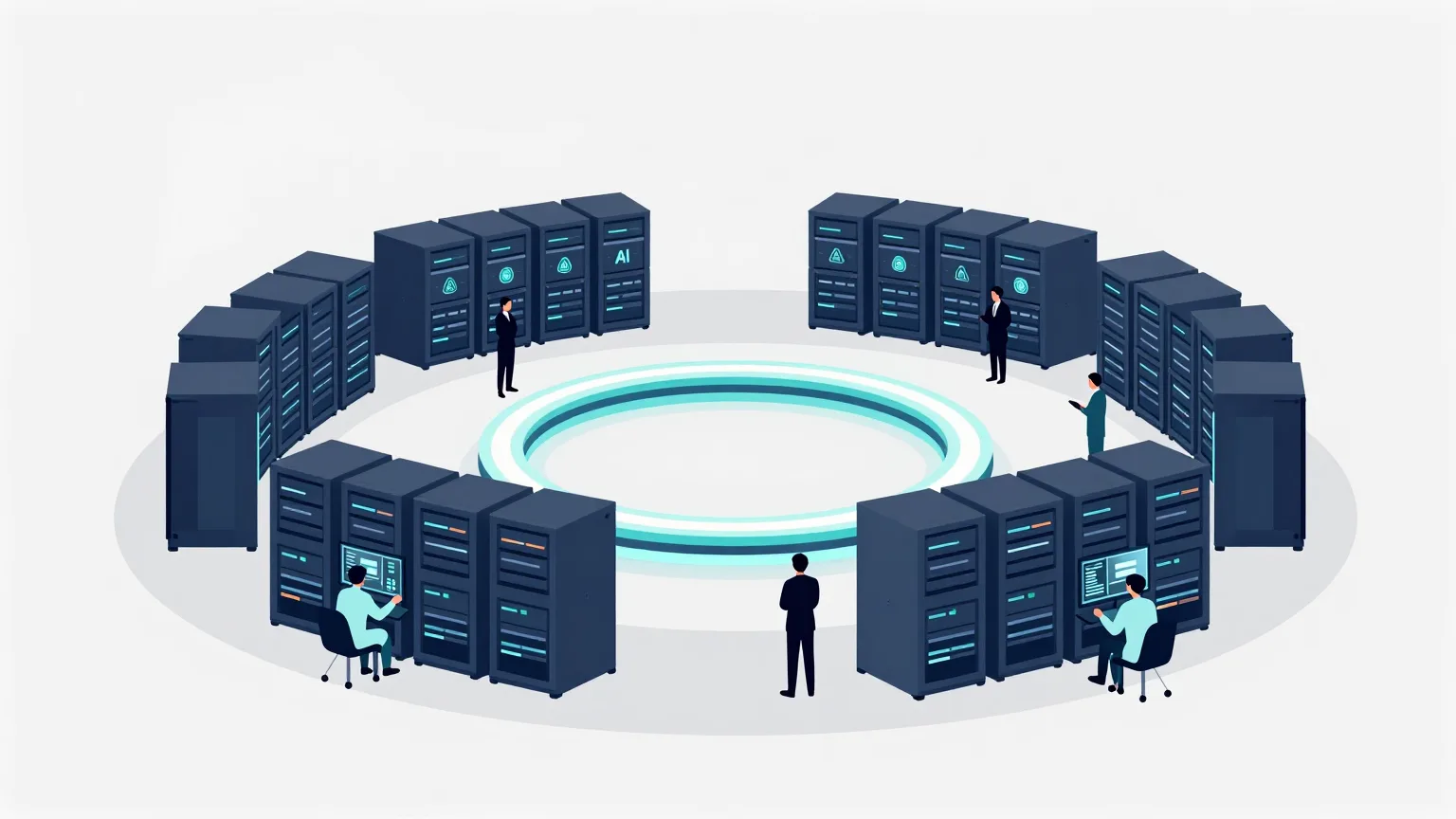
Terence Tao Proposes a "CERN for AI-Assisted Science"
On September 17, Fields Medal-winning mathematician Terence Tao published a post on his blog titled "A CERN for AI-assisted science." As the title suggests, it discusses a vision for a large-scale international shared foundation for AI-powered scientific research—an organization likened to the European Organization for Nuclear Research (CERN).
The original post has only just been published, and the discussion on Hacker News is only now getting underway. For the details, readers should go to the source itself, but Tao has repeatedly reported on his own hands-on use of AI in mathematical research, and this proposal appears to draw on that experience. It will be interesting to see how the direction—from individual researchers using AI to "infrastructure shared across all of science"—is articulated as an actual design.
Training-Free DIY "Jev-Compatible" Setup Delivers Strong Results
"Jev" has been attracting rapid attention over the past few days, and an attempt to perform Jev-style verification with an ordinary open-weight LLM—without any dedicated fine-tuned model—has been reported in Reddit's LocalLLaMA community.
The setup by poster "Malfeitor1235" is simple. Each candidate answer is converted into a true/false (boolean verification) question, and the true/false logits are read without generating any text. The answer is then chosen by applying a softmax to the score differences between candidates. Compute cost is kept in check by evaluating the expensive shared prefix—the state, the question, and the choices—only once, and batch-processing the candidate branches that differ only at the tail with llama.cpp.
On a 32,235-question benchmark, Qwen3-4B scored 65.0% (~27 req/s), Qwen3 27B scored 75.3% (~2.9 req/s), and Qwen3.6 35B-A3B scored 75.5% (~5.3 req/s), all reportedly measured on a laptop-class RTX 5090 24GB. According to the poster, this approach "works surprisingly well" even with untouched, stock models, and in some cases the same model outperformed OpenJev's fine-tunes. One caveat worth noting, though: the poster themselves says they "can't guarantee the benchmark conditions were exactly identical."
The implementation is published on GitHub as a Rust web server and can run Hugging Face GGUF models locally through a Jev-compatible API. As an example of Jev-style efforts expanding from the benchmarking phase into the DIY phase, it is a fascinating one.
Ling 3.0 Tiny vs Gemma 4 26B-A4B — Measuring the Speed/Accuracy Trade-off
Also on LocalLLaMA, a detailed head-to-head measurement of the small MoE model Ling 3.0 tiny and Gemma 4 26B-A4B on the same task was posted. The task is rooted in real operations: part of an audiobook production pipeline that assigns a speaker to each line of dialogue in a novel.
Ling 3.0 tiny is a hybrid KDA/MLA design with 7.9B total parameters and 1.3B active. At Q4_K_M quantization it is only 4.8GB, so the entire model fits on an 8GB VRAM card and prompt processing completes entirely on the GPU. Gemma 4 26B-A4B (QAT Q4), on the other hand, takes 14GB and is run with its experts offloaded to system RAM.
The results were harsh. On speaker assignment across 3 chapters and 485 lines, Gemma achieved 94.6% agreement versus 56.9% for Ling. Ling reportedly could not keep track of who "I" was in first-person narration, and there were many scenes where the narrator's lines were assigned to a different character. It also frequently sent the narrator—explicitly named in the prompt instructions—to "Unknown" as an "unidentified narrator," and neither changing sampling settings nor toggling thinking mode improved the outcome.
On the other hand, Ling was 1.8x faster overall and left 1.5GB of VRAM to spare. The poster calls it the "fastest model I have run on this card" for returning well-formed JSON against 5K-token prompts, making it a strong candidate depending on the task. In the end, though, the poster rejected it—"57% vs 95% is unusable"—and analyzed the issue as "not a settings problem but a capability floor at 1.3B active." A careful, instructive measurement of where exactly the cost of speed comes due.
"Not Everyone in the AI Industry Believes in Extinction Risk" — BBC Report
One popular image of AI holds that "industry insiders are unanimously warning of the risk of human extinction." The BBC report "Not all AI workers think the tech could kill everyone" conveys that this image does not fully match reality. Even among people working at AI companies, views on the risk are split, and the degree of concern differs greatly depending on job type and position.
The debate over "AI safety" has been running hot in Japan as well; if the perceptions of the people directly involved are this diverse, it could provide material for rethinking the frameworks used in reporting and public opinion.
NVIDIA CEO Jensen Huang: "Check Who I Have Dinner With — Their Stock Doubles the Next Day"
According to ITmedia, NVIDIA CEO Jensen Huang made this sardonic remark about the frenzy over GPU investment: "Try finding out where, and with whom, I am having dinner. The next day, that company's stock doubles."
It is a joke, but the remark symbolizes just how much speculation around NVIDIA's GPU supply network and its partners moves markets. In practice, the smallest shred of NVIDIA-adjacent information continues to move related stocks sharply, illustrating how difficult it is to discern where the enormous money will flow.
90% of Japanese Workplaces Have Had No AI Training — Despite Over 40% Wanting to Learn
A survey-based report from ITmedia Keyman's Net found that fewer than 10% of people have ever received AI training at work, while over 40% said they want to learn AI and digital skills. Even as companies are expected to adopt AI and drive DX, AI rarely becomes a topic in the workplace, and training opportunities remain limited. The gap between the desire to learn and the opportunity to do so has been thrown into sharp relief.
A set of Keyman's Net articles published the same day sheds light on other aspects of the front lines. Daiwa Steel Pipe Works has begun an effort to unify its license management—complicated by a growing number of SaaS tools—with an "IT help desk AI," and a survey by Sojitz Tech Innovation found that 87.5% of companies that adopted Copilot/M365 cited "scattered information" as a challenge, while 96.2% expressed expectations for an AI environment that can search across internal information. Even as tool adoption advances, many companies struggle to search and make use of internal knowledge—a picture of both the "human infrastructure, such as training" and the "information infrastructure" failing to keep up.