

Conclusion: The Reasons to Stick with a Single Frontier Provider Will Fade Over Time
The bottom line: as long as model prices keep falling, the value of the "bundling layer" rises relatively, and the inevitability of entrusting everything to a single best-in-class model provider fades — that is the takeaway when reading Fugu Max from a cost-strategy perspective.
Here is the logic. As overall model capability rises, the quality gap between the top tier and the one just below tends to shrink, while the price gap remains. If the difference is small, the rational approach is to go with the cheaper model most of the time and reserve the pricier one for the hard parts. It is an asymmetry: the reason to choose based on performance difference fades, while the reason to choose based on cost difference remains.
That said, this is not a story about frontier models becoming unnecessary. There will still be situations that demand the highest quality ceiling. What is being questioned is dependence — whether everything needs to be concentrated in one provider. This is not a matter of total rejection, but of reallocation.
This is also a pattern that has repeated throughout the history of computing. Just as the industry moved from an era served by a single general-purpose high-performance machine to one built from task-specific server fleets and schedulers, AI too may see its focus shift from "one dominant model" to "a fleet of models plus a conductor layer."
Falling Model Prices and the Value Reversal of the "Bundling Layer"

[Image: A graph showing the relationship between falling model prices and the rising value of the bundling layer]
To put it simply: the cheaper individual models become, the more the outcome hinges on the skill of the conductor layer that combines the models, rather than on which model you "buy."
In an era of high model prices, whether you could buy a good model translated directly into competitiveness. As prices fall and anyone can buy good models, the differentiator shifts to "how well you use them" — that is, the skill of routing and ensembling. The cheaper the components become, the more the design stands out. It is a structure that rewards design.
By analogy with electric power: as the unit price of power plants (models) falls, the contest shifts to the skill of the transmission grid and supply-demand balancing (the conductor layer). The pattern in which commoditized components hand the value to the layer above has been observed in other industries as well.
That said, how far the price decline will continue, and whether the conductor layer's advantage can stand on its own as a product, remain unknown. For now, the honest position is to treat this as "likely as a trend." That judgment, precisely, is something to keep updating as we watch the results of efforts like Fugu Max going forward.
Cases That Suit Conductor AI — and Cases That Don't
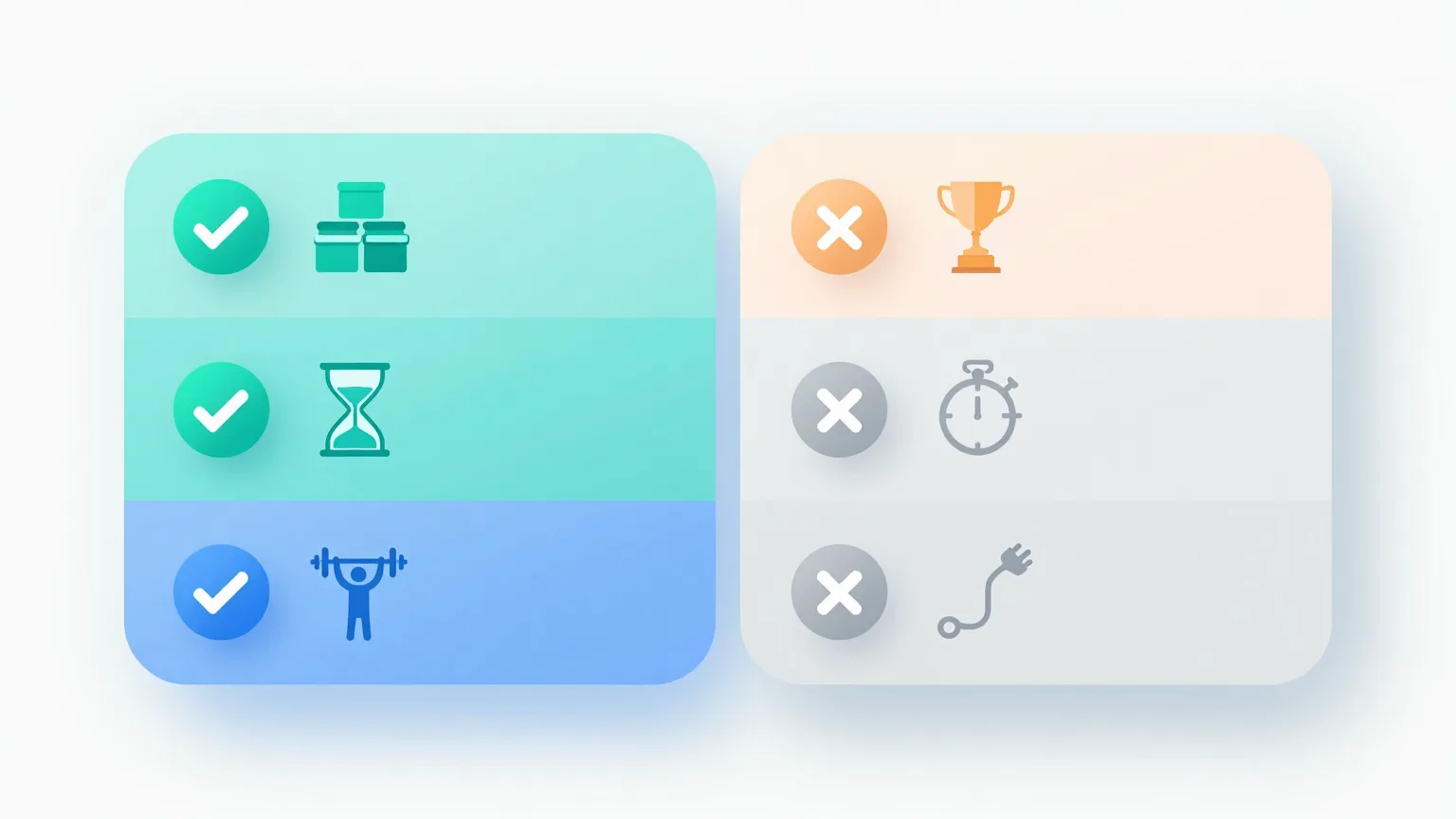
[Image: A checklist of cases that suit and cases that don't]
Broadly speaking, suitability comes down to three factors: the distribution of your tasks, the latency you can tolerate, and your capacity to run it. If all three line up, it is a fit; if any one is missing, steady optimization with a single model will likely deliver results first.
Task distribution is the question of whether the bulk of your processing is routine with only a few hard problems. Latency is the question of whether your service can tolerate the wait time of an ensemble. Operational capacity is the question of whether you can secure the people and time to invest in evaluation and maintenance. Let us go through these concretely below.
Cases Where It Suits Well
First, services centered on a large volume of routine processing with hard problems making up only a small portion. In tasks such as customer support, document summarization, and classification or triage, the benefits of routing scale in proportion to the volume processed.
Second, work where cost is a clear constraint and "good enough" quality suffices. Processing tasks that only need an 80 rather than a perfect 100 on the top-tier model is the most wasteful pattern of all.
And third, teams that have the capacity to trial and compare multiple models and can define their own evaluation metrics. Conductor AI is designed so that the gains flow to those who measure and iterate.
Cases Where It Doesn't Suit
Tasks where failure is not an option and the quality ceiling takes top priority. For work involving consequential judgments, directly using the top-tier model remains the safer choice at this point. If lower prices come at the cost of more failures, the trade is not worth it.
It also doesn't suit latency-sensitive services that cannot tolerate ensemble delays. If your design cannot keep up with the wait time, you should choose a low-latency configuration first.
The same applies to the stage where you lack the resources for evaluation and operation and simply hooking up one API is all you can manage. Conductor AI is a technology that presumes ongoing operation, so if you cannot operate it, deciding not to adopt it looks like the right call.
Three Decision Materials to Prepare Before Adoption
If you are going to try it, I recommend putting three things in place first: evaluation data, cost visibility, and a switchover plan. These three are less a prerequisite for adoption than tools for maximizing the gains once you have adopted it.
Evaluation data is a set of ground-truth examples from your own tasks. Your track record on your own work says more than public benchmark scores. If you can measure per-model accuracy, you can also make swap decisions faster.
Cost visibility means keeping a record of which model was used, for which task, and how much. The optimal routing changes with every price revision, so the ideal is a state where you can recalculate at any time.
A switchover plan means deciding in advance the fallback destination and procedure for when a specific model goes down or raises its price. The insurance of the bundling approach only takes effect once this is decided.
To start small, an experiment routing 20% of your routine tasks to a small model is enough. Measure results and costs, then adjust the routing ratios — this way of running things is itself a miniature of conductor AI operations.
Series Wrap-up: The Other Axis That Sits Beside the Performance Race
What Fugu Max showed us is a way of competing other than aiming for the top of the performance rankings: orchestrating a fleet of cheap models and winning on cost. As model prices keep falling, the importance of this axis is likely to grow.
Looking back on the three installments: part 1 covered the concept of conductor AI and the basics of its cost structure; part 2 covered its two tools, ensembling and routing, and the resolve required to operate them; and part 3 laid out the reading of falling prices and the value reversal of the "bundling layer," along with the decision materials.
I encourage readers to start by reviewing the task distribution of your own service and checking whether there are any parts you are "leaving entirely to the top-tier model." Excessive payments may well be lying dormant there.
Note that for Fugu Max's latest performance figures and implementation details, please turn to the primary sources: Sakana AI's announcements and the Japanese explanatory articles on Qiita. The role of this series is to offer a lens for reading that information. When new reports come out, let us read them again through this lens.