

What Kind of AI Is Fugu Max? Tracing How It Caught Attention
To give the conclusion first: Sakana AI's Fugu Max is an AI built on an approach that, instead of entrusting everything to a single giant AI model, bundles multiple models together like a 'conductor' to get tasks done. Earlier this week, it became a topic when the Fugu series was reported to outperform GPT-6 Astra on some tasks, and it has been drawing renewed attention since a Japanese explainer article (on Qiita) introducing Fugu Max was published.
The reason for the attention lies less in raw performance than in the fact that it 'wins cheap.' Compared with the approach of reaching for an expensive state-of-the-art model every time, it has the potential to deliver good results while keeping costs down — which could shake up the conventional wisdom about how to choose models.
Sakana AI is an AI startup out of Japan, known for a research direction that creates value by combining multiple models and component technologies. Japanese-language explainer articles describe the mechanics of Fugu Max, which sits on that same trajectory, as 'a system that wins cheap without relying on expensive state-of-the-art models.'
For example, a cheap model is often good enough for summarizing text, yet if you route every request to the top-tier model, you end up with bills that keep growing while quality is simply higher than necessary. The conductor AI can be seen as an approach that eliminates this 'payment for excess quality.'
This series runs for three parts. Part 1 (this article) covers the basics of the idea, Part 2 covers the mechanisms known as ensembling and routing, and Part 3 covers what it means as a cost strategy.
What's New About the 'Conductor AI' Idea?

[Image insertion: an image showing how a conductor brings a group of models together]
The key point is not 'recruiting a single virtuoso performer' but 'assembling the best performance from the performers you have.' The conductor AI does not raise each individual model's performance; it improves the overall outcome by controlling how the models are combined and how they work.
To use an orchestra analogy: a conductor does not play an instrument themselves. Even so, by deciding which performer takes which part and when they come in, they can create a performance that goes beyond any individual performer's ability. In Fugu Max, the individual AI models are introduced as the 'performers,' and the control layer that binds them together as the 'conductor.'
Even in conventional AI usage, switching between multiple models has long been done by hand. What's new is providing a 'layer' that handles this selection and combination as part of the system, tied to performance evaluation. Think of it as the conductor layer automatically handling the seat-swapping that humans used to judge case by case.
Take a concrete example: 'a big model for hard questions, a small model for routine processing.' Humans used to make that call every time a request came in; now the conductor layer looks at the nature of the task and decides automatically. This difference matters more and more as processing volume grows.
Single Giant Model vs. Conductor AI: Comparing Strengths and Weaknesses
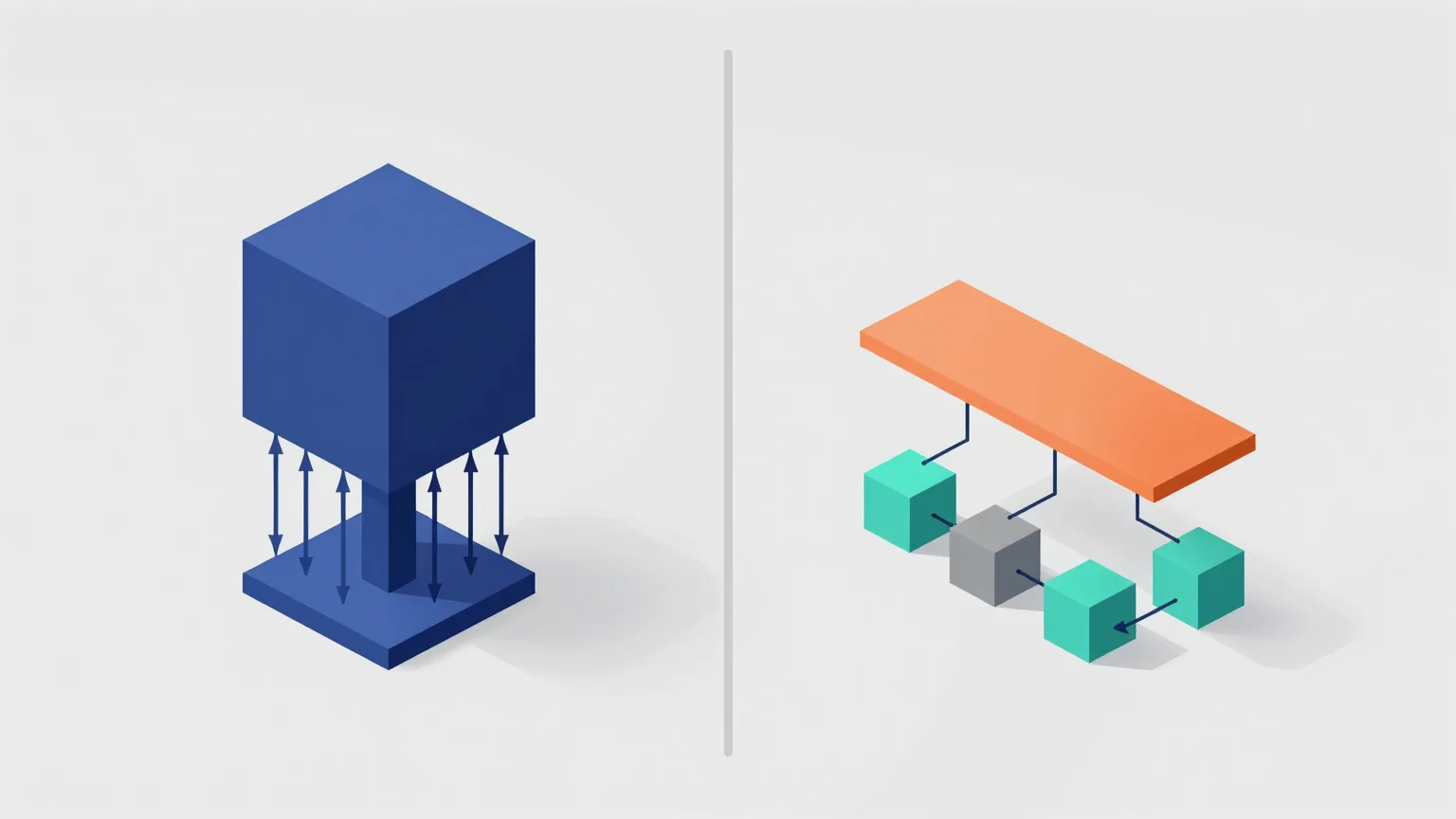
[Image insertion: a comparison diagram showing the difference between one giant model and a conductor AI]
The conclusion: neither is simply better across the board — which to use depends on whether you 'definitely want maximum quality' or 'prioritize cost and flexibility.' Rather than competitors, it is more accurate to think of the two as tools that each shine in different situations.
A single giant model excels where complex reasoning or state-of-the-art quality is required, and its greatest strength is a high quality ceiling. On the other hand, its unit price is high, and it tends to deepen dependence on a specific vendor. A conductor AI can keep total costs down through a combination of cheap models and makes model swaps easy, but in exchange you take on the work of designing and managing the conducting layer.
Suppose, for example, that the vast majority of questions in a customer support chat are routine. Just by designing the system so that only the hard ones go to a top-tier model, you can shift most of your spending to the lower-priced side. Conversely, for decision-making work where failure is not an option — in medicine or legal matters, say — it remains a valid call to prioritize the quality ceiling and use the top-tier model directly.
Below, we take a closer, more concrete look at the strengths and weaknesses of both approaches.
Strengths and Weaknesses of the Giant-Model Approach
The strength is the height of the quality ceiling. There are real situations — difficult reasoning, grasping long context, nuanced writing style — where the top-tier model delivers the most reliably high results. On tasks where the cost of failure is large, that high ceiling pays off.
The weakness is that you end up paying for that quality on every request. High unit prices apply even to routine processing, so as volume grows, the 'over-the-top payments' pile up. It also carries a dependency risk: direct exposure to model deprecations and price changes.
Strengths and Weaknesses of the Model-Bundling Approach
The strength is the fine granularity of cost control. Because you can choose the right-sized model for each task, you can cut spending while achieving the same results. And if a particular model becomes unavailable, it is easy to swap in another, which spreads out dependency risk.
The weakness is that the conducting layer itself must be designed, evaluated, and maintained. Unless you continuously verify which models can be trusted for which tasks, the quality of the combination will not stay stable. The freedom that comes with 'bundling' arrives together with a corresponding share of operational responsibility.
Does 'Winning Cheap' Really Hold Up? Thinking in Terms of Cost
The short answer: it holds up under certain conditions. The basic logic is that if the bulk of tasks can be handled by cheap models and only the difficult fraction goes to top-tier or multiple models, total cost can be brought down substantially.
The mechanism is simple: API pricing is determined mainly by the amount of text processed and the model's unit price. Because the unit-price gap between models is wide, even for the same processing volume, 'which model you assign it to' makes a big difference. The conditions for usage-switching to pay off are readily in place.
That said, if it is 'cheap but lower quality,' the whole exercise defeats itself — the condition is getting cheaper while maintaining quality. Fugu Max made waves precisely because it was reported to match state-of-the-art models on some tasks while keeping its cost structure down; only when both come together does it mean anything.
For example, compare processing all 10,000 daily summarization requests with the top-tier model against splitting them 80% to a small model and 20% to a top-tier model: the latter shifts the bulk of your spending to the lower-priced side. Actual amounts depend on each provider's pricing, but you can easily picture how the gap tends to widen structurally.
Note that for Fugu Max's specific scores and the details of its model composition, please check the primary sources: Sakana AI's announcements and the Japanese explainer article (on Qiita). This article focuses on laying out the conceptual and cost-structure perspectives.
Part 1 Recap: Three Points to Remember
This article makes three main points. First, Fugu Max is an AI built on an approach that bundles multiple models together like a 'conductor.' Second, the heart of the attention lies not in performance rankings themselves but in the 'win cheap' cost structure. Third, there are situations where each approach fits or does not, and where the quality ceiling is the top priority, giant models remain the solid choice.
Supporting this way of thinking are two techniques: ensembling and model routing. In Part 2, we will dig into these two with pseudocode and work toward understanding what's inside the conductor AI.