
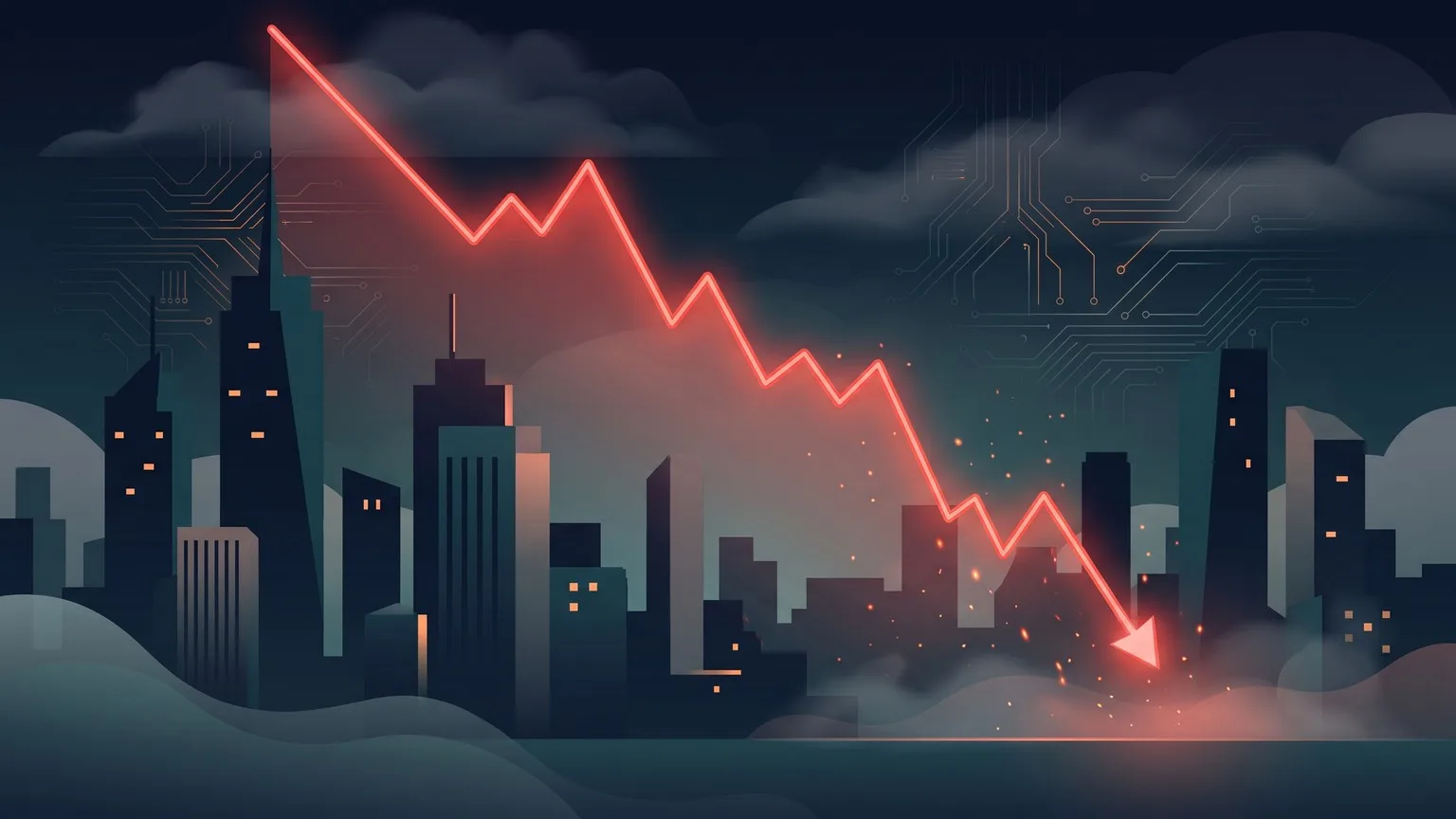
Friday in U.S. markets was the day the cracks in the "AI trade" that has propelled stocks throughout 2026 finally spread across the indexes. The S&P 500 fell 3.7%, pushing its decline from October's record high to 10% and meeting the definition of a technical correction. On the product and defense front, though, the moves kept coming: OpenAI strengthened countermeasures against leaks of internal reasoning, Google introduced Gemini-driven Mac control, and Signal unveiled screenshot blocking as a defense against AI agents.
S&P 500 Enters Correction as AI-Related Stocks Rack Up About $4 Trillion in Losses
According to Bloomberg, the S&P 500 fell 3.7% in New York trading, widening its drop from the October peak to 10% and crossing the threshold for a so-called technical correction. By investment research firm Bespoke Investment Group's count, this is only the sixth time since World War II that the index has fallen on all five trading days of a week, with declines of more than 1% on at least four of them. Nvidia sank to an 18-month low as the scandal surrounding its leadership deepened, and the Wall Street Journal reported that losses on AI-related stocks have reached roughly $4 trillion.
Anthropic Gives Up Most of Day-One Gains on Day 2 of the Largest IPO on Record
Anthropic, which staged the largest IPO in history on Thursday, was sold down to near its IPO price at one point on Friday before closing at $88.30, down 9.1% from its first-day close — surrendering the bulk of its day-one gains. Even so, its market capitalization stands at roughly $1.6 trillion, keeping it among the top 15 listed companies in the world. The selling pressure appears to stem less from the company's own performance than from eroding confidence in the AI sector as a whole. Just a day earlier, the headlines were about a 17% first-day pop; within a single session, nearly all of it has vanished.
Wired Report: Huang's "Lies" Had Nvidia's Board on Alert
Wired reports that as multiple affair allegations surfaced — a relationship with a direct report as well as an alleged relationship with someone identified as a Chinese spy — what troubled the board most was former CEO Jensen Huang's "lack of candor." The direct trigger for his resignation was not any individual allegation, the report says, but the fact that the company's leader had not been forthright with the board.
Separately, two Democrats on the House Foreign Affairs Committee — Sydney Kamlager-Dove and Gregory Meeks — sent a letter to Commerce Secretary Lutnick demanding records of communications between Nvidia and the bureau in charge of chip-smuggling investigations, over suspicions that Nvidia sought to influence a probe related to Megaspeed, a Singapore-based cloud company. Alice Huang — who is suspected of being a Chinese spy and whose relationship with Huang he has acknowledged — served as an executive at Megaspeed.
OpenAI Dramatically Strengthens Defenses Against Leaks of GPT-6.2's "Thinking"
OpenAI announced that it has substantially strengthened defenses for GPT-6.2 Astra and GPT-6.2 Sol against attacks that attempt to extract the models' internal reasoning. In adaptive red-teaming tests, the success rate for extracting the protected internal reasoning reportedly dropped from 54% to 0.2%. The company is also continuing to suspend accounts — thousands to tens of thousands per week — in response to activity it believes to be coordinated distillation campaigns. OpenAI describes the effort as a layered approach combining model training, defenses, detection, and enforcement — a sign that preventing capability leakage to competitors has become a central concern for frontier labs.
Google Gemini's "Computer Use" Can Operate Mac Apps in the Background
Google has shipped a "Computer Use" feature in Gemini for Mac. The AI can operate desktop apps, local files, and websites inside a background window separated from whatever the user is working on. A live preview lets users keep an eye on what the AI is doing while carrying on with their own work. With Meta, OpenAI, Anthropic, and Google rolling out device-operating agents in quick succession — and Apple reportedly preparing to enter as well (recent reporting suggests it will also raise access barriers for rivals) — the agent race, now entering the practical stage, looks set to intensify further.
Signal Moves to Block AI Agents From Reading Private Messages, an "Existential Threat"
Signal will block screenshots on iOS 27 and Android. The company described AI agents such as Apple's Siri AI, Google's Gemini Intelligence, and Meta's Muse reading the screen and touching private chats as an "existential threat" to privacy. It acknowledges, though, that the protection is still incomplete, with macOS not yet covered. Signal is also calling on Apple, Google, and Microsoft to follow suit with similar OS-level measures. It is arguably the first concrete example of the rise of AI agents forcing messaging apps to rethink their defensive design.
Analysis of Roughly 10 Million Chinese Job Postings: AI-Exposed Roles Declining 10 Points Faster
Bloomberg News analyzed roughly 10 million Chinese job postings and found that postings for occupations highly exposed to AI declined about 10 percentage points faster than those for other occupations. Entry-level roles and the creative industries have been hit hardest; more than 90% of China's booming micro-dramas are now produced with AI. Cai Fang, a former adviser to the People's Bank of China, warned that "the bigger AI shock is yet to come." As empirical evidence of AI squeezing the labor market, it is an analysis of remarkable scale.
Wrap-Up
In the markets, the ebbing of the AI trade has the look of a turning point spreading across U.S. indexes — but the pace of individual product and R&D activity has not changed. All in all, a somewhat unbalanced weekend: defense (OpenAI's leak countermeasures, Signal's blocking) and the practical deployment of agents (Gemini's Computer Use) advancing at the very same time.