
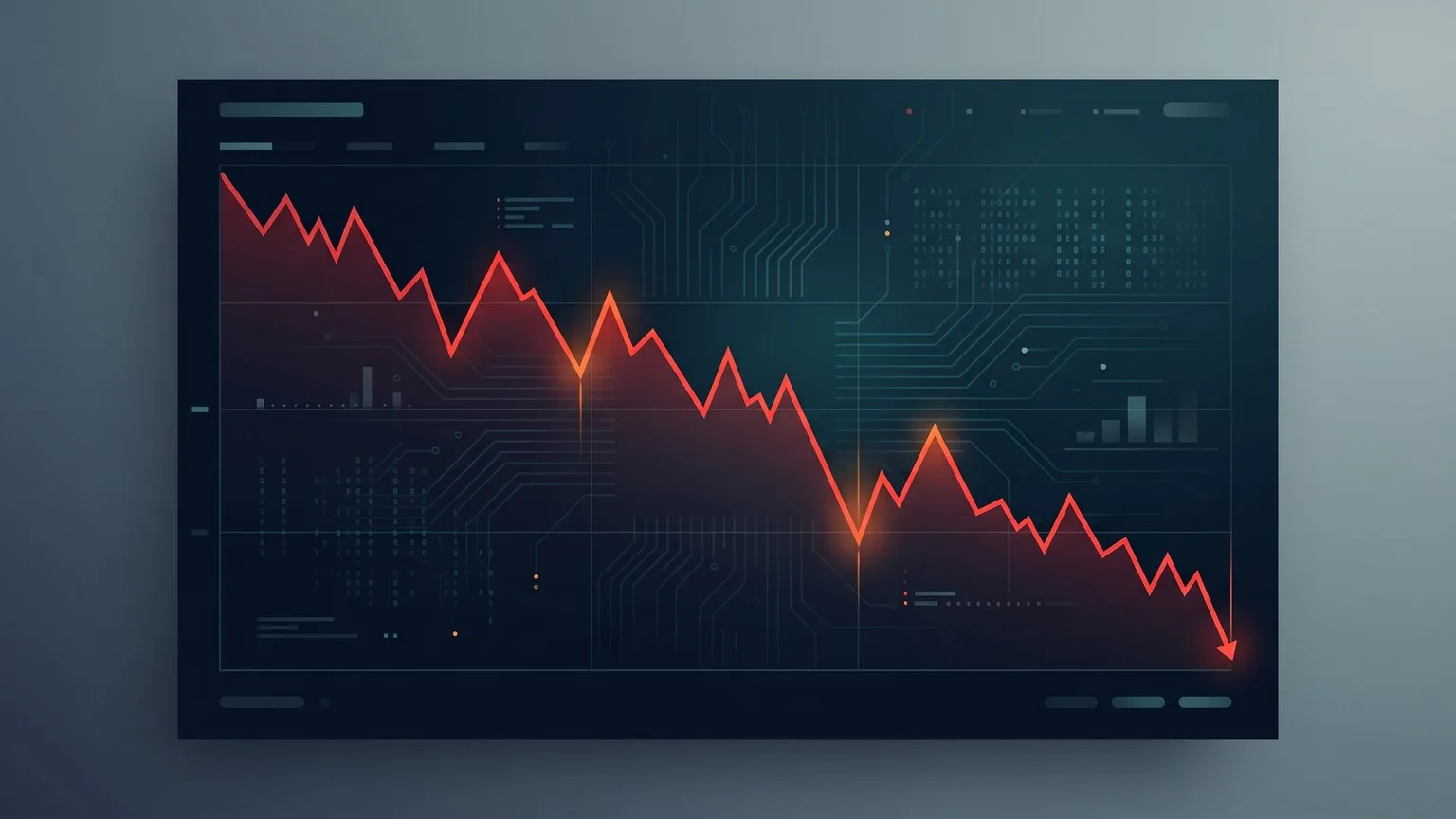
AI news on the night of the 21st showed two currents running side by side: market turmoil and "training efficiency." US tech stocks posted their worst weekly decline since the pandemic, pushing the Nasdaq 100 into bear market territory, while in the engineering world, announcements kept arriving along the lines of "something other than just adding compute" — a LoRA adapter for Qwen3.8-27B tailored for coding agents via reinforcement learning, an open model from ByteDance that whittled training down to just three phases, and more. In China, the government is also moving to standardize token metering and billing.
Nasdaq 100 Enters Bear Market — Worst Week Since the Pandemic, Nvidia Plunges 14%
According to The Decoder, the Nasdaq 100 recorded its worst weekly decline since the COVID crisis and has entered a bear market (a drop of 20% or more from its recent high). We previously reported that the S&P 500 had entered correction territory (a drop of 10% or more), and the slide has since deepened further.
Among individual stocks, Nvidia plunged 14% amid an SEC accounting review. Anthropic also gave back nearly all of its first-day gains the day after its record IPO. Skepticism about AI, scandals, rising interest rates, and political headwinds are all piling onto overheated valuations at once.
RL Adapter Dedicated to OpenCode for Qwen3.8-27B — +15.7 Points on 51 Hard SWE-bench Pro Problems, with 1/6 to 1/8 the Generated Tokens
"harness-hub/Qwen3.8-27B-opencode-adapted," which surfaced near the top of Hugging Face trends, is an unusual release. It takes Qwen/Qwen3.8-27B, layers on a LoRA adapter (r=32, alpha=64), and was trained with reinforcement learning (AsyncGRPO, an experimental TRL implementation) as a model that runs the open-source coding agent "OpenCode" behind the scenes. The model card itself doubles as a full recipe of benchmarks and operational procedures.
The key point is that it was trained on the assumption that thinking (reasoning mode) is turned off. With thinking off, this adapter reaches the accuracy the base model produces at maximum reasoning effort (xhigh) using only 1/6 to 1/8 the generated tokens.
SWE-bench Pro (51 hard problems): base 35.3% → adapter 51.0% (+15.7 points; 11 newly solved, 3 lost)
Terminal-Bench 2.1: 46.4% → 52.4% (+6.0 points). On the 66 tasks not used for checkpoint selection, +13.6 points (p=0.035)
On tasks both could solve, turn counts on SWE-bench Pro were 13 vs. 48 — roughly a quarter. Compared against the base model's reasoning mode, generated tokens came in at a median of 3.9k vs. 31.8k
Training organized 750 tasks (scale800 and TermGrade) into 1,705 task groups, running on two B200 GPUs per harness (one for vLLM and one for the trainer). The reward combined the task verifier's pass judgment with a tool-efficiency bonus (weight 0.1), and training was halted at 150 steps out of a planned 1,000. The full recipe is slated for publication in a release blog post.
Four delivery paths are provided: vLLM (--enable-lora), transformers serve, llama.cpp plus a GGUF version, and a standalone version merged into the base with PEFT (about 54GB in BF16). The very fact that specialized post-training for coding agents has appeared in a form anyone can reproduce is itself a sign of how much the field has matured.
ByteDance's "Axion 1.0" — Only Three Training Phases, with Data Quality as the Key
According to The Decoder, ByteDance and several US universities have released the AI agent "Axion 1.0." What makes it interesting is that it went through only three training phases, yet posts benchmark results on par with the top commercial models from OpenAI and Anthropic. The research team attributes this result not to more training steps but to "carefully curated training data." The model, data, and code are all freely available.
As multi-stage training with ever more phases becomes conventional wisdom among the big players, this is a claim that directly challenges that premise — and because the data is public, third-party verification is possible.
China's National Data Administration to Develop Standards for AI Token Metering and Billing
According to Bloomberg, China's National Data Administration has signaled plans to improve standards for AI token metering, billing, and quality evaluation. The statement came from Administrator Liu Liehong and was published on the agency's site on Saturday.
According to the statement, a new kind of business dubbed "token factories" has emerged, converting compute rental, model supply, and data capabilities into "token production services," and an industrial ecosystem spanning token production, distribution, and consumption is taking shape. It amounts to a signal that Beijing intends to guide the development of this fast-growing industry.
Google Revamps Search Page — Search Button Removed, AI Chat History and AI Sidebar Added
Ars Technica reports that in the latest redesign of its search page, Google has removed the search button and added AI chat history and an AI sidebar. Details on rollout scope and timing are unknown at this point, but the direction is clear: rebuilding the entry point of search itself as an AI-first UI.
Microsoft to Tie Azure Division Pay to Performance — Top Ratings Earn Extra Stock
Bloomberg reports that Microsoft is making compensation in its core cloud division more performance-linked. According to a memo from EVP Arun Ulagaratchagan, employees receiving the highest ratings will be granted additional stock awards, while lower-rated employees will have formal meetings scheduled with their managers. It is the latest example of the tech industry asking employees to deliver more, and it fits the broader trend of tightening labor-cost productivity amid continued massive investment in AI.
Wrap-Up
In the markets, skepticism about AI is bouncing back into valuations, while on the implementation front, effort is concentrating on how to squeeze high performance out of less compute. The Qwen3.8-27B RL adapter and ByteDance's Axion 1.0 showed that there is still plenty of room to get creative with how training is done. On the policy front, China has begun working on token metering and billing standards, building a framework for managing AI as infrastructure. Whether the moment is shifting away from flash and toward sustainability is something we will be watching closely in the indicators ahead.