
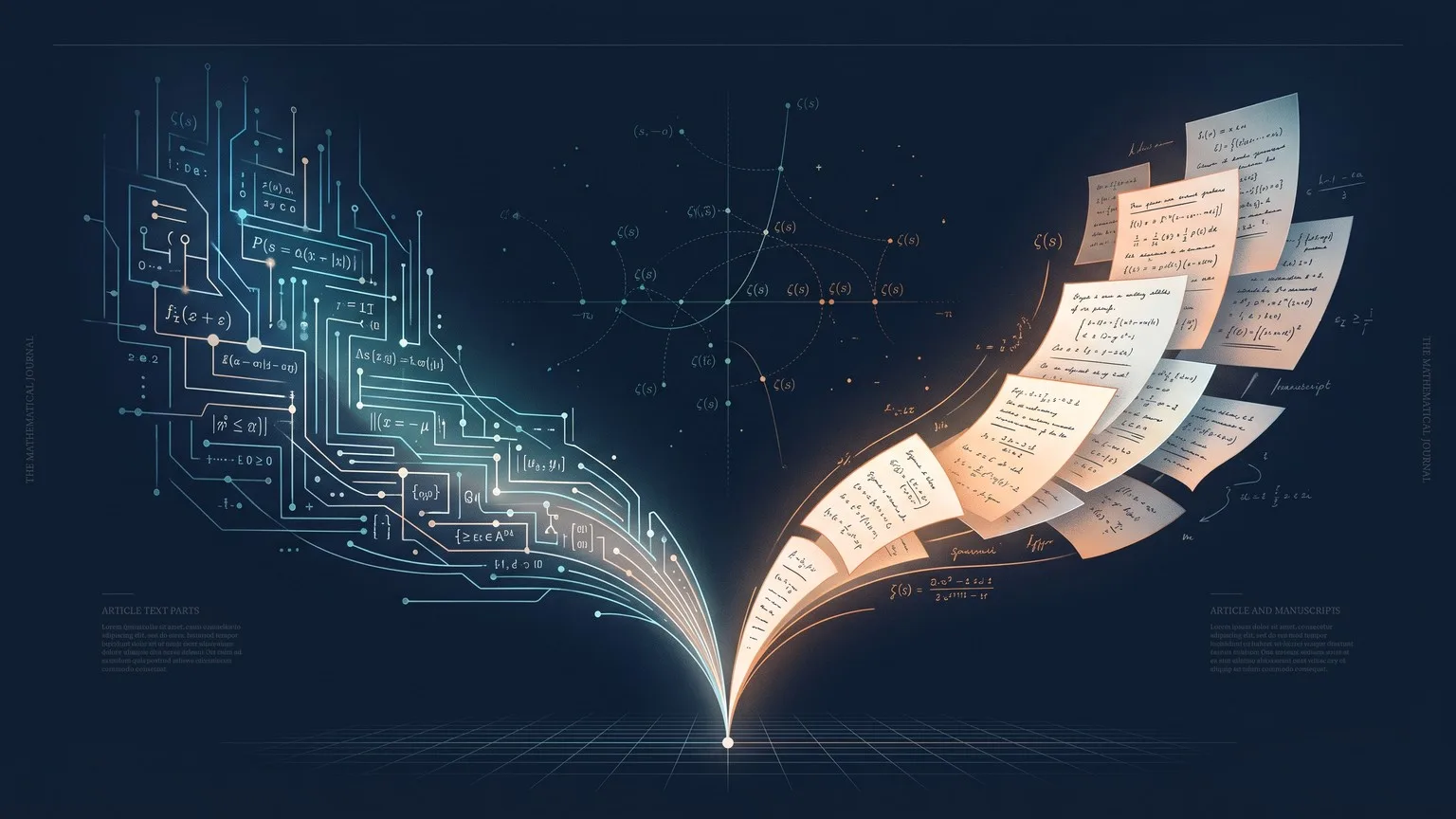
The AI news from the weekend through the 21st was dominated by a single mathematical announcement. Multiple reports and statements from those involved revealed that the story The Economist had earlier covered as a possible case of "AI solving mathematics' most important problem" was in fact a claimed proof of the Riemann hypothesis — and that two such claims, one by AI and one by humans, had appeared on the same day. Beyond that, Thinking Machines Lab released "Inkling 2 Mini", an open-weights model that runs on a laptop; the US and Chinese leaders announced an agreement on AI "shared guardrails"; and Cloudflare published the weights of an invoice-reading model — a dense day of announcements all around.
Two "Proofs" of the Riemann Hypothesis on the Same Day — a Lean Proof Built with Claude, and a Human Proof Twelve Years in the Making
As noted previously, The Economist reported that AI may have solved mathematics' most important problem; subsequent reporting and announcements from those involved have now confirmed that this was a claimed proof of the Riemann hypothesis (and its generalization, the GRH). What's more, two independent claims appeared within hours of each other on the same day.
The first came from Levent Alpöge, a mathematician at Anthropic. He says he found the proof "in collaboration with Claude", and rather than a paper, he released the code of a formal proof written in Lean (1.3GB, roughly 250,000 pages if written out). Work began on October 6; of the 20 total stages, 8 were completed on November 15 and the final stage on November 16. Claude reportedly contributed heavily to the parts dealing with automorphic forms on higher-rank groups, which Alpöge himself considers outside his strength — "Near the goal, Claude left me far behind. No — it flew, danced, and shone," as he put it. Mathematician Elliot Glazer confirmed that the formalized statement is the GRH, and assessed the probability of a bug slipping into the Lean code at under 1%. If it compiles to completion without extra axioms, it is "probably correct" — though it is possible no human will ever read the whole thing.
Inspired by this, Alessandro Masullo released a second claim: a 940-page proof draft. His is "100% human", the product of twelve years of preparation, with review and revision reportedly carried out in secret.
The newsletter Latent Space summed up the contrast: "The AI proof is probably correct but unreadable. The human proof is probably technically flawed but readable." As the example of OpenAI's September claim about the Navier–Stokes equations — criticized because "the Lean proof and the natural-language results don't match" — shows, verifying Millennium Problems involving AI is expected to take years. Meanwhile, Anthropic stock fell about 10% on the day.
Whether this result should be read as "proof of superhuman ability" is contested. Some suggest that "maybe we never really grasped the objective difficulty of mathematical problems in the first place"; others see it as olympiad-style "brute force executed at a scale human perseverance could never match"; and still others point to the lopsidedness of a capability that solves a Millennium Problem while still being "not this smart at a thousand other things" (its jaggedness). Whichever interpretation is right, we intend to watch with appropriate reservations until verification is complete.
Thinking Machines' "Inkling 2 Mini" — a 26B Loop MoE That Circles 12 Layers Three Times and Runs on a Laptop
Thinking Machines Lab, led by Mira Murati, has released "Inkling 2 Mini", a 26.4B-parameter loop-style MoE, under the Apache 2.0 license. The pitch is that it is "strong for a size that runs on a laptop": the architecture runs 12 shared intermediate layers in 3 passes, carrying gated information between passes, which yields an effective 5.4B active parameters counting the loop. It accepts images in addition to text, and its context length extends from a native 256K to 1M via YaRN.
On performance, it claims the top spot among open models under 100B with 48.2% on DeepSWE v1.1 and 46.5% on Vals Index v2.2. Reports also cite comparisons showing it beating the previous-generation Inkling 1.0 at 2.7% of the size, with a figure of 49.3% on ARC-AGI-2 (about $0.14 per task).
It is also well-engineered for local execution. Training was done end-to-end at low precision in nvfp4, and Unsloth, which published quantized versions, reports that even with 1-bit quantization roughly 90% of top-1 outputs are preserved. vLLM supports it on day 0, as do Ollama, llama.cpp, and MLX; Unsloth's GGUF quantized builds target 16GB of RAM.
What's interesting is how the release is framed. The company explains it as a release intended to let outside researchers study how the loop structure affects the observability of chain-of-thought. A research model with a variable number of passes was released alongside it, and the reported results show that long-context tasks score higher as passes increase, while knowledge benchmarks do not. The release works not just as a "small but strong model" in itself, but as a tool for investigating what happens inside it.
After the Gemini 4 Launch — Neon Wins Praise from Developers, and the API Gains Tool Retrieval and Audio Editing
The rollout of the Gemini 4 series that Google announced last week continues. Practitioner reviews of Gemini 4 Neon, the variant drawing attention for coding-agent use, have been pouring in. Lucas Beyer compared it against Opus 5.5, Muse Wonder Full, and Sol 6.2 on building a data viewer, finding that "Neon's output was the most data-aware." It scored 87.4% on Company Agent Bench, ahead of Fable 5.2 (82.2%) and GPT-6.2 Astra (79.7%), and debuted in second place on the Agent Arena Index with 1336 points.
Speed-focused Gemini 4 Hydrogen is now available in the Gemini app and Search, and the API has gained Dynamic Tool Retrieval, which resolves lazily loaded functions and remote MCP servers on the server side, plus a public preview of audio editing via Gemini 3.5 Transcribe. There are also reports that from December 2 the Gemini subscription will be usable in any harness (no official confirmation at this point).
On the other hand, some testers have voiced complaints about total costs — one reported paying $4.60 for what amounted to 15M tokens on a simple demo — and there are concerns about the terms of service for the Antigravity development environment (account suspension and restrictions on headless use), as well as Simon Willison's observation that the relationships among Neon, Carbon, Argon, and Hydrogen are hard to follow.
Microsoft Ignite — MAI Code 2, Claiming "96% of Opus 5.5's Performance at 5% of the Cost"
At Microsoft's annual Ignite conference, the company announced its own model, "MAI Code 2". It claims to deliver 96% of Claude Opus 5.5's performance at 5% of the cost, announced alongside the Autopilot agent and the Decision-1.1 router that dispatches work across models. Verification by independent benchmarks is still to come, but the approach — near-frontier performance at a bargain price — is a clear counter to OpenAI, Anthropic, and Google. With cost competition set to intensify further, the time has come to reassess model selection criteria on both performance and price.
US and China Apparently Agree on AI "Shared Guardrails" — Plus New Chip Manufacturing Rules and Smuggling Estimates
On the policy front, President Trump said he had agreed with Chinese President Xi Jinping on "shared guardrails" for AI. No specifics were disclosed, so it appears to be an agreement on a framework for now.
Hardware-side regulation is also in motion. New US government rules could block TSMC and Samsung from manufacturing AI chips for Chinese companies. Meanwhile, research institute Epoch AI, analyzing trade records, estimates that more than $3 billion worth of servers may have been smuggled via Malaysia — equivalent to roughly 150,000 units in H100 terms. GPU provider Nscale reportedly needs a license to grant ByteDance remote access, and ByteDance accounted for about 73% of its 2025 revenue.
On the Nvidia front, following Jensen Huang's resignation as CEO (and the surrounding turmoil), Trump has reportedly asked him to return as CEO. Last week's "return under discussion" has now advanced to the stage of "presidential involvement."
Cloudflare Releases the Weights of Invoice-Reading AI "Clairic" — Self-Hostable under Apache 2.0
Cloudflare has released the trained weights of "Clairic", a document-extraction model that reads invoices and receipts, along with a lighter "Clairic-flash", both under Apache 2.0. Both are reported to be post-trained from Qwen-family models (based on Qwen3.8-27B and Qwen3.5-9B, respectively); they take text, images, and PDFs of up to 4 pages as input, and output typed fields, confidence scores, and the relevant spans.
In regulated industries such as banking, where invoices cannot be sent to third-party APIs, there has long been demand to run this kind of model on one's own infrastructure. It was just released, so there are no independent benchmarks yet, and how well it handles multilingual invoices including Japanese remains an open question — but the trend of "releasing models for practical, real-world tasks under permissive licenses" steadily widens the options for local LLM use.
Wrap-up
The two claimed proofs of the Riemann hypothesis simultaneously raise questions about AI's reach into mathematics and about how "correctness gets verified." Inkling 2 Mini and Clairic point to a direction where open weights create value through "ease of use and practical fit" rather than state-of-the-art performance. On policy, the US–China framework agreement and tighter chip regulation are moving in parallel; among companies, cost competition (MAI Code 2's bargain-price claims, complaints about Gemini API pricing) keeps intensifying. Precisely because flashy claims keep coming, we want to maintain the discipline of carefully tracking only verifiable information.