
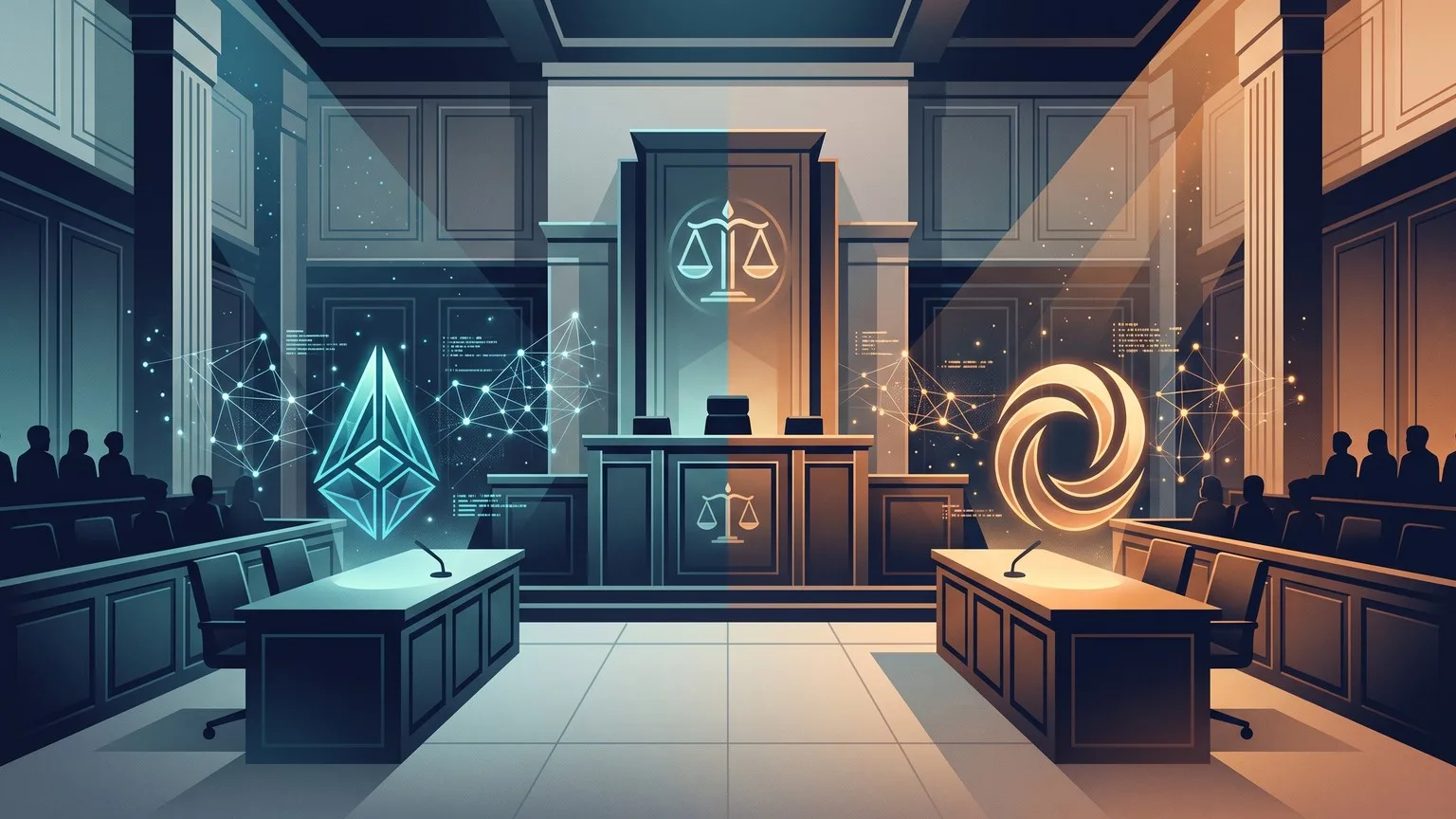
October 14 delivered a day of AI news spanning the courtroom, the investment ledger, and the front lines of real-world operations. The biggest headline: the trade secret lawsuit between Apple and OpenAI reaches its first critical juncture. Add Meta CEO Mark Zuckerberg pulling back the curtain on his mega-investment decision, plus Japan's first university-wide deployment of Claude, and it was a day when AI's money, safety, and education stories all moved at once.
Apple–OpenAI Lawsuit Heads to Its First Major Hearing
According to Bloomberg, Apple and OpenAI will face their first high-stakes proceeding at a hearing this Wednesday, one that could tip the direction of the entire case. The iPhone maker sued OpenAI, alleging it was scheming to steal confidential information about future products, and the hearing is expected to take up two key issues.
The first is Apple's request for a court order to immediately halt use of the trade secrets it claims were stolen. The second is OpenAI's motion to throw the lawsuit out entirely. In other words, the proceeding will decide both whether an injunction is granted and whether the case survives at all — and whichever way it goes, the outcome could shape how companies across the AI industry handle each other's information. With a final ruling thought to be months away, the first gate has now opened.
Zuckerberg: "I Wrote $200 Billion in Checks Not Knowing Whether It Would Work"
Also from Bloomberg: a candid retrospective from Meta CEO Mark Zuckerberg. Appearing on the podcast "Cheeky Pint", Zuckerberg talked about his frame of mind when he committed hundreds of billions of dollars last year to the infrastructure underpinning Meta's AI products.
"It turned out I was going to write checks for like $100 billion or $200 billion," Zuckerberg recalled, adding that he had asked Chief AI Officer Alexandr Wang, "Is this really going to work?" With no way to know whether the AI products would succeed, only the infrastructure commitment had to be locked in first — testimony that even a giant was fighting uncertainty. Markets keep casting a cool eye on the scale of the spending, and how these remarks are received in the context of that debate is another thing to watch.
Anthropic Co-founder Speaks at the University of Tokyo: "Probability of AI Building AI to Exceed 50% in 2027"
Anthropic co-founder Jack Clark delivered a lecture at the University of Tokyo and put forward a striking forecast. On the probability of AI becoming able to train its own successor models, he moved his forecast up from earlier this year, saying it would exceed 50% by 2027 (ITmedia AI+).
Clark, however, described actually carrying out such recursive self-improvement (RSI) as a "one-way ticket," stressing that whether to go through with it is a question society should decide. What makes his remarks distinctive is that he separated the technical possibility from the judgment of whether to allow it.
He also noted the likelihood that AI is being used in the wave of cyberattacks on Japanese companies, pointing to the risk of open models being abused; Bloomberg likewise reported his comment that "open models are risky." The debate over the trade-off between openness and safety has now been joined on Japanese soil as well.
Digital Hollywood University Deploys Claude Campus-Wide — a First for a Japanese University
In domestic news, Digital Hollywood University announced on October 14 that it will roll out Anthropic's generative AI "Claude" across the entire university. From November it will be offered to all students and all faculty and staff, making this the first university-wide deployment of Claude at a Japanese university (ITmedia).
What sets it apart is the all-you-can-use arrangement — no counting usage — creating an environment where Claude can be used for learning and operations without usage-cap constraints. In educational adoption of generative AI, billing models have long been a barrier, and this will be watched as a leading example of how institution-wide licensing spreads.
AI Agent in Sweden Erases Edited Footage of an Unaired Show
What Swedish outlets reported was a real-world case of an AI agent accident. On broadcaster TV4's reality show "The Challenge Sverige", a technical failure related to an AI agent deleted the edited material, and the entire season was lost just weeks before its scheduled broadcast (Aftonbladet, Sweden Herald).
The show is reportedly postponed until 2027. It was neither an attack nor malice — the lesson of this incident is that an agent in operation unintentionally wiped live data. The case turned a spotlight on backups and permission design when agents are given write access to production data, even in the field of entertainment.
Anthropic Opens Fifth APAC Office in Singapore, Signs MOU with the Government
On October 14, Anthropic announced the opening of its Singapore office, its fifth location in the Asia-Pacific region. The company has also signed a memorandum of understanding (MOU) with Singapore's Ministry of Digital Development and Information (MDDI).
Singapore is one of the company's most active markets in the world, with Claude already running behind services that millions of people use daily, such as GovTech Singapore, Grab, and DBS. The MOU lists cooperation on AI safety, security, and model evaluation; research into the impact of AI adoption on society; and responsible deployment across both the public and private sectors. The signing took place during Singapore International Cyber Week — one more example of AI safety cooperation advancing at a national scale.
Wrap-up
A courtroom standoff (Apple vs. OpenAI), the uncertainty of mega-scale investment (Meta), the safety debate (Anthropic), adoption in education (Digital Hollywood University), and an accident in real-world operations (Sweden's TV4): every front of the AI story moved at once in a single day. An agent destroying production data is not someone else's problem — it is a fresh reminder of how much permission design and backups matter.