
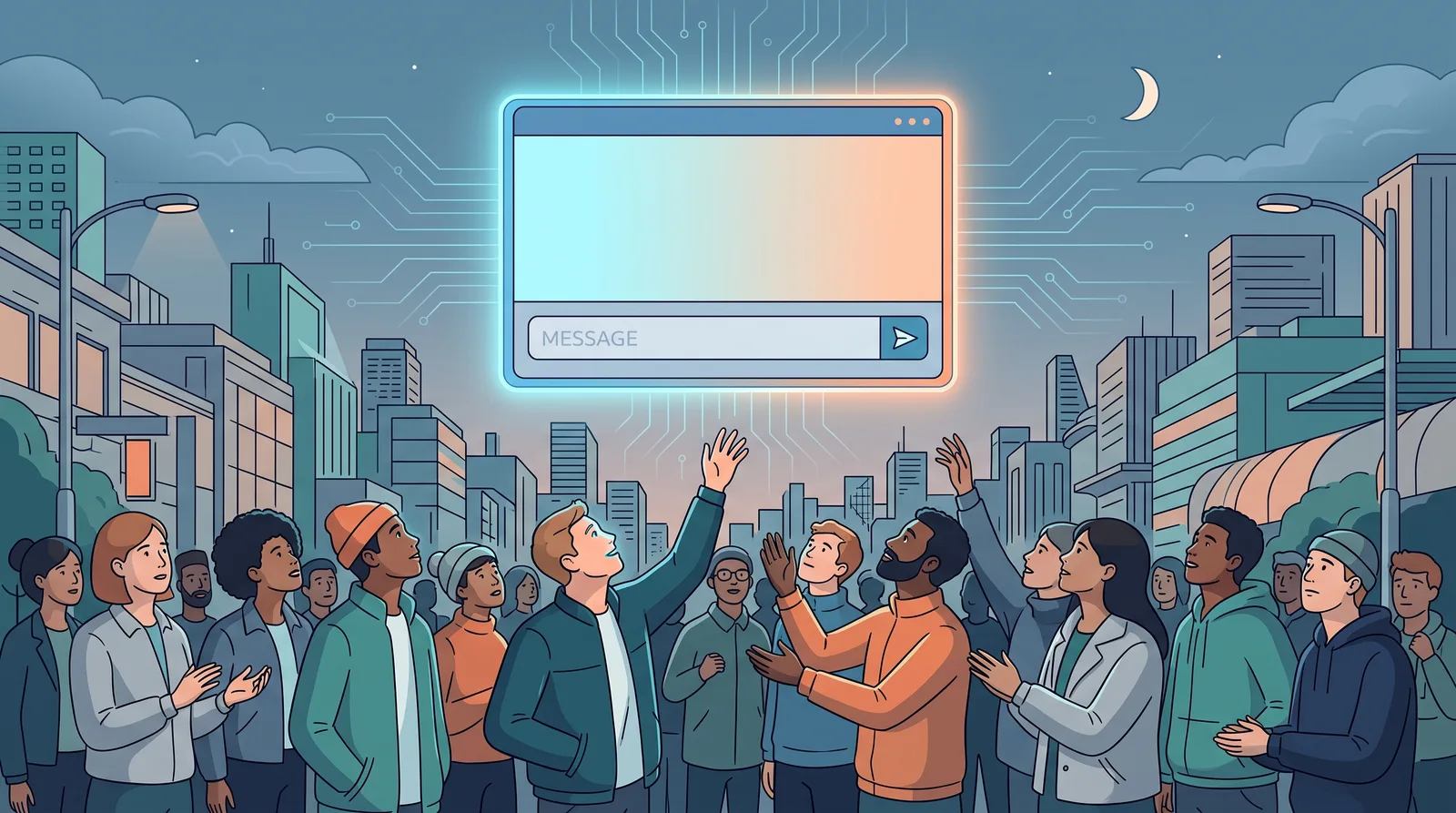
On October 5, OpenAI announced a new visual ad format for ChatGPT, along with expanded measurement tools for advertisers, attribution partnerships, and brand suitability efforts. The move doubles down on monetization amid mounting user backlash — and fittingly, the same day MIT Technology Review published an analysis asking why people hate AI yet can't stop using it. On the regulatory front, Norway was reported to be preparing a proposal to temporarily ban AI glasses in some public spaces. In South Korea, cyberattacks on six banks leaked the personal data of more than 25,000 people, and two of the banks estimate the attacks involved AI agents. In Japan, Toshiba expanded its nearline HDD production lines, banking on "data infrastructure" demand in the AI era.
OpenAI Introduces New Visual Ad Format for ChatGPT
On October 5, OpenAI announced that it will introduce a new visual ad format for ChatGPT. The company also said it will expand advertiser-facing initiatives, including extended measurement tools, partnerships around attribution (measuring which ads drove outcomes), and brand suitability safeguards.
The summary made public as of collection time does not touch on details such as rollout timing or placement. It remains an open question whether ads in a conversational UI can work the same way traditional banner ads do, so we will be watching future official announcements to see what they actually look like.
Hating AI yet unable to quit it — MIT Technology Review analyzes why
An analysis published by MIT Technology Review on October 5, "People really hate AI, so why can't they get enough?", sharply captures the current mood.
The survey figures the article rounds up all point to the same contradiction. In a Pew Research Center survey, more American adults expect AI to have a negative impact on themselves and society than expect a positive one, with pessimism especially strong among younger generations. Stanford's AI Index report found that more than half of the world says AI products and services make them nervous. In a Gallup survey in May, 71% of U.S. adults opposed building a new AI data center in their area — far surpassing opposition to new nuclear power plants (53%). And in an NBC poll in March, AI was less popular than U.S. Immigration and Customs Enforcement (ICE).
And yet, usage keeps climbing. According to market analytics firm Sensor Tower, ChatGPT reached 1 billion monthly users in May, and Google DeepMind's Gemini stood at 950 million as of July. Pew found that half of U.S. adults now use chatbots — more than double the 2023 figure — and one in four uses them daily. Across the 38 OECD member countries, more than a third of adults said they had used generative AI tools in the past three months.
Are the haters and the users separate groups? Probably not. The author points out that the two circles now largely overlap. A correlation is also on display: the Global North, where adoption is most advanced, is the most pessimistic, while the Global South, with lower usage rates, skews optimistic. The author's read is that what people hate is not the technology itself, but the relentlessness of the companies pushing it on them in every form imaginable.
Social media played out the same pattern for 20 years. But with AI, the article argues, there are still moves left on the board. All 50 U.S. states have passed or proposed laws regulating AI development and use, with related bills exceeding 2,100 — a tenfold increase in three years. And given that credible open-source alternatives to Google, OpenAI, and Anthropic already exist in the market, consumer choice could still generate market pressure.
MIT expert committee: "AI is eroding the college experience"
From the same MIT comes a warning for the classroom. On October 5, The Decoder reported on findings compiled by a committee of MIT experts.
According to the report, AI is eating away at core parts of college life. Office hours spent visiting professors, study groups, and flagship research programs for undergraduates are all in decline, and trust between faculty and students is breaking down. Some professors are even weighing AI agents instead of students as research assistants.
The university most deeply intertwined with AI's origin story has now called for a sweeping rethink of higher education. It seems the paradox described earlier — can't stop using it, yet trust is collapsing — has surfaced in concrete form inside the campus itself.
Norway to propose "temporary ban" on AI glasses in public spaces
According to a Reuters report on October 5, Norway is expected to propose a temporary ban on AI glasses in certain public spaces.
Details such as the scope of covered locations, the duration of the ban, and how violations would be handled could not be confirmed as of collection time. The move appears to be driven by concerns over devices that continuously record with cameras and analyze the footage with AI. Once the formal proposal is published, we will be watching how it is positioned within the broader currents of European AI regulation.
Cyberattacks hit six South Korean banks — data of over 25,000 leaked, AI agents suspected
South Korea has seen a string of cyberattacks on banks since late September. According to local newspaper reports covered by ITmedia on October 5, six banks were attacked, and the personal data of more than 25,000 people in total leaked from four of them, including Shinhan Bank. Two of the attacked banks reportedly estimate that the attacks were carried out using AI agents.
The reports hint at the possibility that agents automating everything from reconnaissance to intrusion and data exfiltration were used in the wild — a case drawing attention as an example of attackers "going AI" in ways that could affect the defense of financial infrastructure too. Within the range of what local reporting has revealed, the details of the attack methods remain unclear, so we will have to wait for the results of the South Korean investigation.
Toshiba expands nearline HDD production lines — betting on "data infrastructure" demand in the AI era
Toshiba Devices & Storage, the Toshiba Group company in charge of HDD manufacturing, announced that it has expanded its production lines for high-capacity "nearline HDD" storage (ITmedia, October 5).
Training and operating generative AI requires storing enormous amounts of data, and demand for the storage that underpins data centers is expected to grow. Nearline HDDs are generally a class of products used to retain large volumes of data at low cost despite infrequent access, and the company is building out capacity to capture "data infrastructure" demand in the AI era. At a time when many insist HDDs are being replaced by SSDs, Toshiba is answering the question "why HDDs, and why now?" with where the demand actually sits.
Other stories that caught our eye
A site to try Aleph Alpha's "Kolibri 78B" for free gets attention**: The r/LocalLLaMA community on Reddit highlighted a website that lets you try "Kolibri 78B", a model from Germany's Aleph Alpha, for free in the browser. It is drawing attention as an easy on-ramp to a European-born model.
Finance teams spend 26% of working hours verifying AI output**: An article covering Datarails' 2026 CFO survey made the rounds on Hacker News. The numbers laid bare how the cost of having humans check AI output is eating into the benefits of adoption.
AI agents are disrupting open source security disclosure**: An InfoQ article, "AI Agents Are Disrupting Open Source Security Disclosure", was shared widely. It argues that a surge in vulnerability reports filed via AI agents is straining the open source security disclosure process.
Do people prefer stories written by AI?**: Cambridge University Press has featured a study titled "Do people prefer stories written by AI?". It examines how generated writing is actually being judged, and is likely to draw interest in education and publishing circles.