
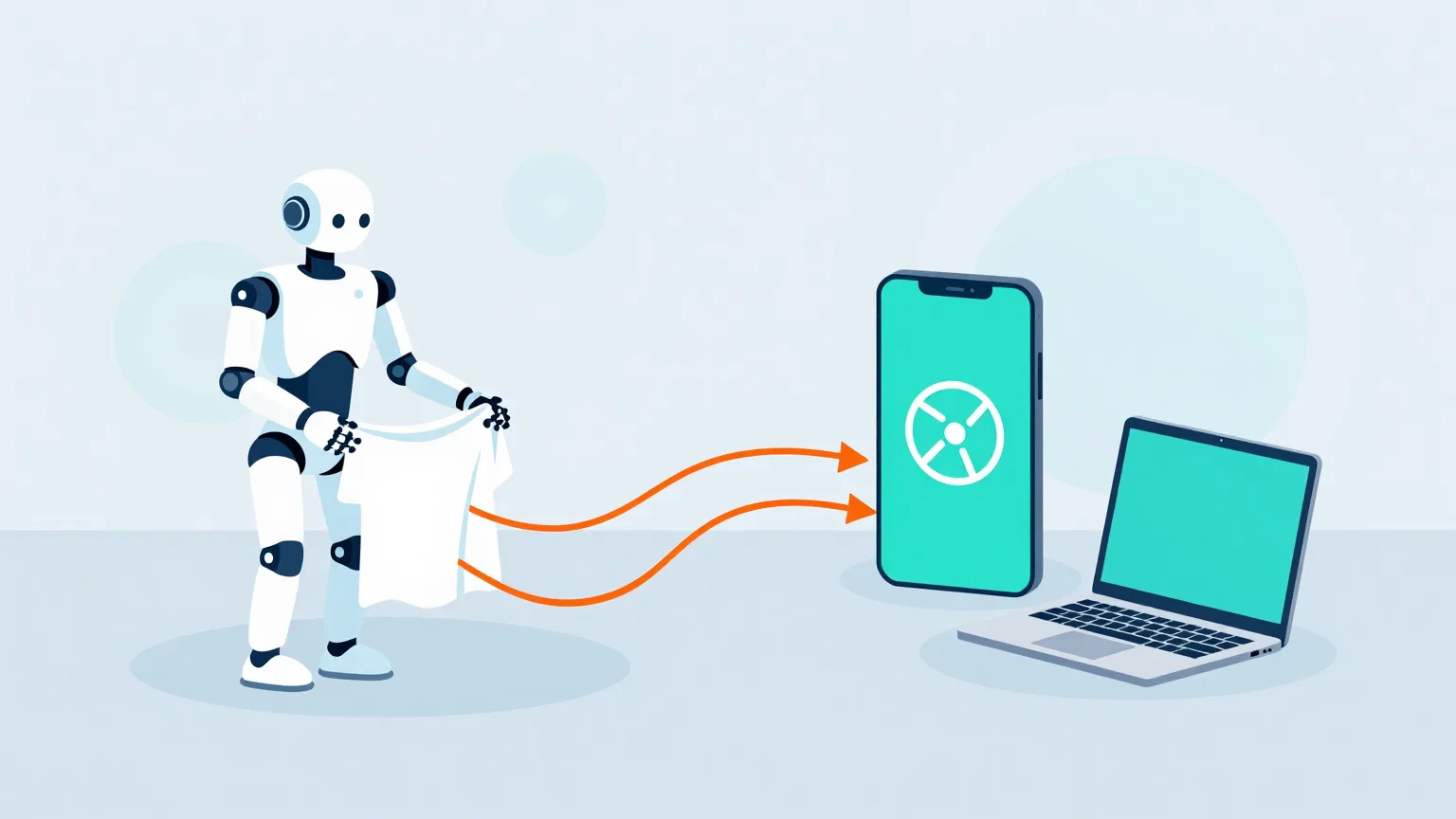
Beyond merely "using AI from the outside," this cycle of news was marked by efforts to remake the tools and machinery around it. Anthropic added a system called "Mods" to its coding agent Claude Code, letting developers rewrite a tool's internals with code. In robotics, Unitree released a 6B-parameter humanoid foundation model that reportedly handles 64 tasks—from making the bed to folding laundry—with a single model. Among individual experimenters, attention went to a report on turning an iPhone 17 Pro Max into a second GPU for a Mac and speeding up Qwen 27B prefill by up to 44%. In the OSS world, SWC stopped accepting external PRs, citing AI-generated content. And on the architecture front, "Spotlight" arrived, boasting memory whose access cost does not grow even as it keeps expanding.
Claude Code Gets "Mods" — Rewriting the Tools Themselves in JavaScript
Anthropic is adding a new system called "Mods" to Claude Code, its CLI-based coding agent. According to The Decoder, Mods is middleware that runs directly inside tools, letting developers reshape interfaces and behavior with JavaScript and TypeScript. Expected uses include adding custom panels, intercepting tool calls, and wiring up new commands.
Customizing coding agents has until now mostly lived at the "configuration and prompts" layer—instruction files, skills, and hooks. Mods opens up the layer beneath. What the agent sees, what it permits, and how it responds become things you can write as code. If the center of gravity for extension shifts from prompts to programs, a new software layer—"agent middleware"—could start to grow, much as dashboards did around BI tools. For developers who make Claude Code their workplace, the day they can reforge the tools themselves to fit their own workflow looks close at hand.
"Transformers Stop Thinking Too Early" — A 65,537-Parameter LoRA Lifts Accuracy from 15.5% to 99%
A study drawing attention on Hugging Face's Daily Papers exposes an unexpected weakness that persists inside LLMs. The experiment is simple: when asked to directly resolve reference chains like "K = apple; B = K; D = B; print(D)" without writing chain-of-thought (CoT), 13 base models ranging from 0.6B to 32B could accurately trace only 1.4 to 3.6 lines. Making the models deeper changed nothing—scaling OLMo-3 from 7B to 32B left the reachable depth at about 2.6 lines.
What is astonishing is the smallness of the intervention. Train a rank-8 LoRA (65,537 parameters, all base weights frozen) on layer 14 of Qwen3-8B, and accuracy on 24-line chains jumps from 15.5% to 99%. A longer-trained version traces up to 50 lines in a single forward pass. Mechanistically, the LoRA itself moves no information between tokens; instead, it kick-starts a "relay" in the frozen intermediate layers, where each line hands its meaning on to the next. Cut the layers where each line attends back to its parent line (14–22) and accuracy falls to chance, while cutting later layers (23–29) barely matters. The injection site is razor-sensitive: the same recipe reaches 20.5 lines at layer 20 but plummets to 5.2 lines at layer 21. On multi-hop QA (MuSiQue), an LoRA attached at early layers reportedly delivered EM gains of 9.4 to 17.9 points across three standard models.
"They have the computational capacity—they just stop too early." A problem that adding parameters could not solve falls to a tiny intervention placed in exactly the right spot. The result suggests there is still untouched design space between model scaling and post-training fine-tuning.
Unitree's "UnifoLM-WLA-1.0" — A Humanoid Handling 64 Whole-Body Tasks with a Single 6B Model
Unitree Robotics has released UnifoLM-WLA-1.0, a general-purpose humanoid foundation model. What stands out is how decisive the trade-offs are: 6B parameters, trained on roughly 2,500 hours of real-robot data. A single model covers 64 tasks in total—10 whole-body tasks and 54 tabletop tasks—and supports both parallel grippers and two different dexterous hands. Its spatial reasoning is also said to outperform multiple open-source models on embodied benchmarks.
The architecture is unusual as well. Starting from UnifoLM-ER-1, a Qwen3-VL-based embodied reasoning model, it adds future dynamic-region prediction via optical flow and VQ-VAE, residual VQ that discretizes the end effector, hands, and lower body separately, and layers an MMDiT action expert on top for continuous control. In the released videos, the G1 humanoid makes the bed, loads clothes into a washing machine, folds laundry, and sorts items.
In robotics, the focus is shifting from models covering partial capabilities such as manipulation or dialogue toward "Whole-body VLA," where one foundation model drives the entire body. As public implementations go, UnifoLM-WLA-1.0 is among the more complete, and it may serve as a foothold for research.
Turning an iPhone 17 Pro Max into the Mac's Second GPU — Qwen 27B Prefill Up to 44% Faster
In the local LLM community, an experiment that drafted leftover silicon into inference duty made waves. On a 24GB M4 Pro MacBook, you can only fit 8-bit context up to 64k next to Qwen 3.8 27B (IQ4_XS quantization). So the author plugged the iPhone 17 Pro Max from their pocket into the Mac with a single 10Gb/s USB-C cable. The Mac computes layers 1–40 of each 256-token batch and streams the activations to the phone; while the iPhone processes layers 41–64 on the A19 Pro's GPU (matrix units that support Metal 4 tensor operations), the Mac moves on to the next batch. With this pipelined division of labor, the A19 Pro's share reportedly ran 2.4× faster than without using the matrix units.
The results are crisp: loading a 2,000-token file into an agent session (prefill) improved from 109 tok/s to 157 tok/s (+44%) at 16k context, 101 to 130 (+29%) at 32k, and 87 to 113 (+30%) at 48k—roughly a 30% gain across the board. Cold-starting a 27k-token session shrank from 245 seconds on stock llama.cpp to 168 seconds. Beyond 64k, the iPhone's role changes: old KV pages are offloaded to the phone while the Mac runs all 64 layers. As of this writing, the Neural Engine has reportedly begun taking part in that offloading too.
Multi-GPU talk usually conjures data centers, but this experiment showed that the "smartphone in your pocket" can be mobilized as a second compute resource. If the GPUs and Neural Engines of iOS devices work as practical inference resources, the options for Mac users could broaden considerably.
SWC Halts External PRs — Drawing a Line Against AI-Generated Content Reaches OSS Too
SWC, the fast Rust compiler/transpiler, announced on its X account that it has stopped accepting external pull requests, citing a growing volume of AI-generated content.
Stories with the same shape keep coming. The arXiv submission rate limits covered last time were likewise a response to "plausible-looking contributions" flooding a place where the cost of generation has dropped to nearly zero. This time, that wave has reached OSS maintenance. The more commonplace AI-assisted coding becomes, the more the human cost on the reviewing side grows in relative terms. We have entered an age where each project must state explicitly what it accepts and what it refuses. Will halts like this—chosen to protect maintainers' workload—keep being selected elsewhere, or will moves emerge to rethink the review machinery itself? It looks set to become a new flashpoint in the debate over OSS sustainability.
Percepta's "Spotlight" — Separating Ever-Growing Memory from Unchanging Intelligence
Startup Percepta has announced Spotlight, a new architecture that replaces attention. The claim is bold. Every token reads from and writes to an unbounded memory, yet because the model learns to index individual memory cells, each token only ever touches a small subset of them. Per-token access stays constant as the memory grows, and utilization can be driven ever lower. Unlike MoE (Mixture of Experts), which activates a fixed number of experts, the degree of sparsity itself is free to vary—that is the stated distinguishing feature.
The design philosophy is "separation." An intelligence module that performs computation is split off from the memory that holds knowledge, procedures, and working state, and the weights do not change as the memory grows. What to load and when to overwrite are decisions the model itself makes, token by token. The memory can hold not only facts but also skills, so the system can reportedly acquire new capabilities without retraining.
For teams running LLMs in production, having to retrain or fine-tune every time knowledge is added has long been a pain point. If separating intelligence from memory and growing only the latter pans out at a practical level, model updates and knowledge updates can run on different cycles. The architecture has only just been announced, and systematic comparisons with other models are still to come, but it is a direction worth watching.
Mods that rewrite tools from the inside, a foundation model that drives a whole body at 6B, spare silicon in your pocket, lines drawn against mass-produced contributions, memory that keeps growing. Rather than model performance itself, it is the surroundings of the model that are taking shape—such was the cross-section of the day.