
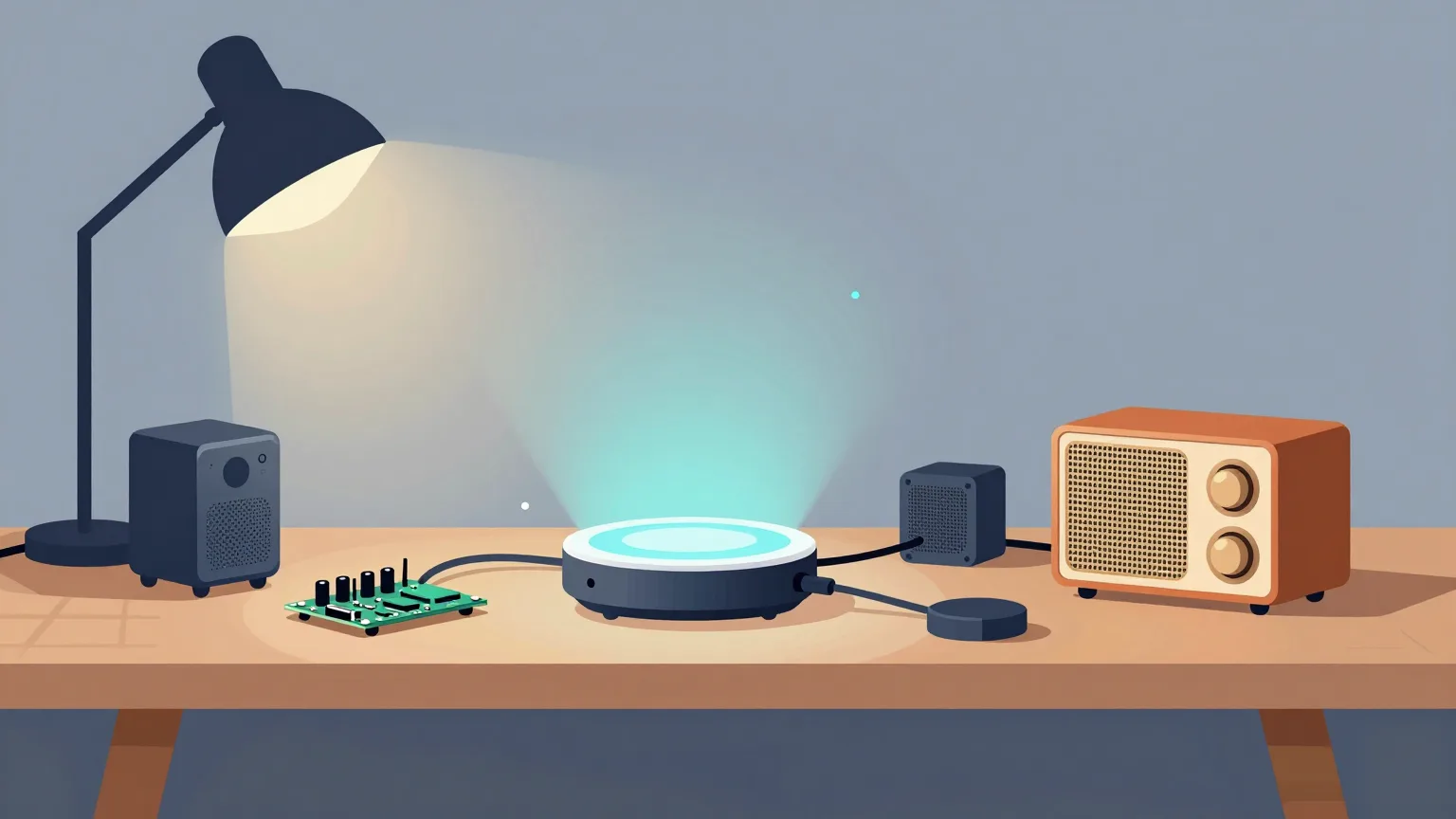
It was a day of AI stepping out of the screen and into the physical world. Meta has let go of an SDK for homemade gadgets as open source, aiming to deliver its personal AI, Muse, to televisions and toasters alike. Apple has fleshed out, for developers, the macOS permission overhaul we covered last time — a move that comes against the backdrop of the Muse message-reading controversy. In academia, arXiv has committed to rate-limiting submissions in response to a flood of AI-generated papers, while researchers are also struggling under a deluge of requests from AI bots. On the developer side, a real-world measurement drew attention: 96.3% of Claude Code's token consumption went to re-reading past context. Here is a cross-section of a week in which convenience and its friction are both growing at once.
Meta's "Muse Gadgets" — SDK for Homemade Gadgets Released as OSS, Dedicated Hub "Home Link" Offered Free
Meta has announced "Muse Gadgets," a project that lets anyone build their own gadgets that work with its personal AI, Muse. The SDK for affordable board computers such as the ESP32 and Raspberry Pi has been open-sourced on GitHub. Alongside it, Meta will provide a dedicated device called "Muse Home Link" — which connects homemade machines and home appliances to Muse — free of charge to paid subscribers in the US. TechCrunch summed it up: "Meta wants to put Muse in your TV and your toaster. So it's giving away the code for free."
What stands out is how it's being given away. By open-sourcing the SDK, Meta sets up a structure in which it doesn't have to build every device itself — developers around the world create the "entry points" to Muse for it. The low barrier to entry, where you can start with nothing more than a single Raspberry Pi, directly overlaps with the DIY hardware culture, unlike skill development in the early smart-speaker era. You can also read the dedicated Home Link hub as an on-ramp for people who never pick up a soldering iron. It looks like the first large-scale stepping stone toward AI assistants expanding from "a presence inside apps" to "a presence inhabiting every device in the home."
Apple Details Its Full Disk Access Crackdown — The Muse Message Controversy and Meta's Rebuttal
The story we reported last time — that Apple was heading toward stronger macOS permissions — has taken on concrete shape. In an announcement aimed at developers, Apple said it will change how the macOS "Full Disk Access" permission works in order to prevent third-party app developers from abusing access to message history. To curb the data-leak risks that come with increasingly autonomous AI agents, the plan is to introduce explicit user actions and additional controls.
The likely trigger was an exposé by tech columnist Jason Aten, who reported that Muse, Meta's general-purpose AI agent, sent him a notification referencing an Apple Messages thread he had no memory of granting permission for. On social media, sympathy reportedly spread for the view that "an AI assistant with access to your calendar, email, messages, and shopping accounts is like a power tool — capable of real damage if used the wrong way."
In response, Meta CTO David Singleton countered that for Muse to access Apple Messages, a user must manually grant two permissions: macOS's Full Disk Access and the Messages connector setting on the Muse side. The picture is not "it read messages on its own" but "the user had granted permission without realizing it" — and what Apple is trying to change is precisely that "unnoticed permission." As agent convenience shakes the assumptions behind OS permission models, this marks a turning point where platforms have begun crafting "permission design for agents."
arXiv Rate-Limits Paper Submissions — Researchers Face "Another Flood" of AI Bots
The Register reports that arXiv, the paper preprint server, has introduced rate limits on submissions in response to a flood of AI-generated papers (so-called AI slop). Infrastructure built on the assumption of human writing, peer review, and distribution has become unable to withstand mass-produced submissions whose generation cost approaches zero.
Meanwhile, the damage isn't limited to the submission side. Nature reports that AI bots are blasting researchers with large volumes of requests demanding "money and time." Automated requests disguised as interview asks, surveys, and requests for collaboration are reportedly straining research workplaces. Cheap generative AI has enabled the mass production of "plausible-looking content" in two directions at once: submissions and requests to humans. Academia now faces a new kind of problem — being crushed by sheer volume.
"96.3% of Claude Code's Token Consumption Went to Re-Reading Context" — Agent Costs Are Decided by Cache Design
A measurement-heavy article gaining traction on Zenn offers plenty of food for thought. An author troubled by the weekly caps of flat-rate plans and API bills measured "what the tokens were actually spent on," and found that 96.3% of consumption went not to the text they had the AI write, but to re-reading past context (cache reads). After reworking their workflow, they had the AI re-measure five weeks later and got "it's down 86%" — but the author suspected "maybe I simply hadn't used it much that week," and is working out how to measure the effect correctly. The refusal to take AI-generated tallies at face value is itself instructive.
The design-side answer to the same problem is arriving too. On September 22, 2026, OpenAI announced improvements to prompt caching for GPT-6, along with features for monitoring and diagnosing cache hit rates. Another Zenn article explaining the change lays out a design that carves out the common parts an agent tends to resend on every turn during long runs (system instructions, tool definitions, reference material) as a fixed prefix, separated from the variable context. The longer an agent runs, the more "re-reading" dominates the cost. Design that doesn't break the cache is becoming as much a developer concern as falling per-token prices.
An AI Radio DJ Becomes a Star in LA — Human Pushback Follows
According to the Los Angeles Times, an AI radio DJ has become an overnight star on Los Angeles airwaves — and drawn pushback from human hosts. With a chatbot-based "DJ" moving into everyday broadcasting, the debate over the future of "voice work" has started to move within the US broadcasting industry. After generative music AI, AI has now entered the full loop of live broadcasting, including track selection and on-air talk. That is not a distant issue for listeners in Japan either.
Four Years of Qiita, 105,160 Posts, Mapped by Tag — The "Land of AI" Grows from a Small Island into a Continent
On Qiita, an article has been published that collected 48 months' worth of posts — 105,160 in total — from October 2022, the month before ChatGPT's release, through September 2026, and visualized the tags as a "map." The AI-related territory, it turns out, had grown from a small island at first into a continent. As an attempt to show with numbers, rather than personal recollection, how the spread of generative AI rewrote the topic composition of Japan's developer community, it's a fascinating piece.
Keep AI inside the screen, or let it out into the world? Meta is betting on the latter, Apple is trying to absorb the risks through design, and academia is busy distinguishing itself from mass-produced "plausible-looking stuff." These past few days have brought the flip side of convenience into view at the same time.