
Your morning AI news roundup for September 28. Anthropic has released a research preview of the "Model Hardware Standard" (MHS), a common specification for AI agents to safely operate laboratory and manufacturing equipment such as microscopes and robotic arms, to its first partners. Alongside this, the company announced free Claude subscriptions for 10,000 scientists worldwide, suddenly making its "support for science" strategy concrete. On the political front, CEO Dario Amodei is reported to be sitting down to his first one-on-one dinner with President Trump, and where their standoff over AI safety heads is drawing close attention. In the local LLM scene, an inference engine that runs a 125B MoE model on an M1 Max has been making waves.
AI Agents Operating Lab Equipment: What Is Anthropic's "Model Hardware Standard"?
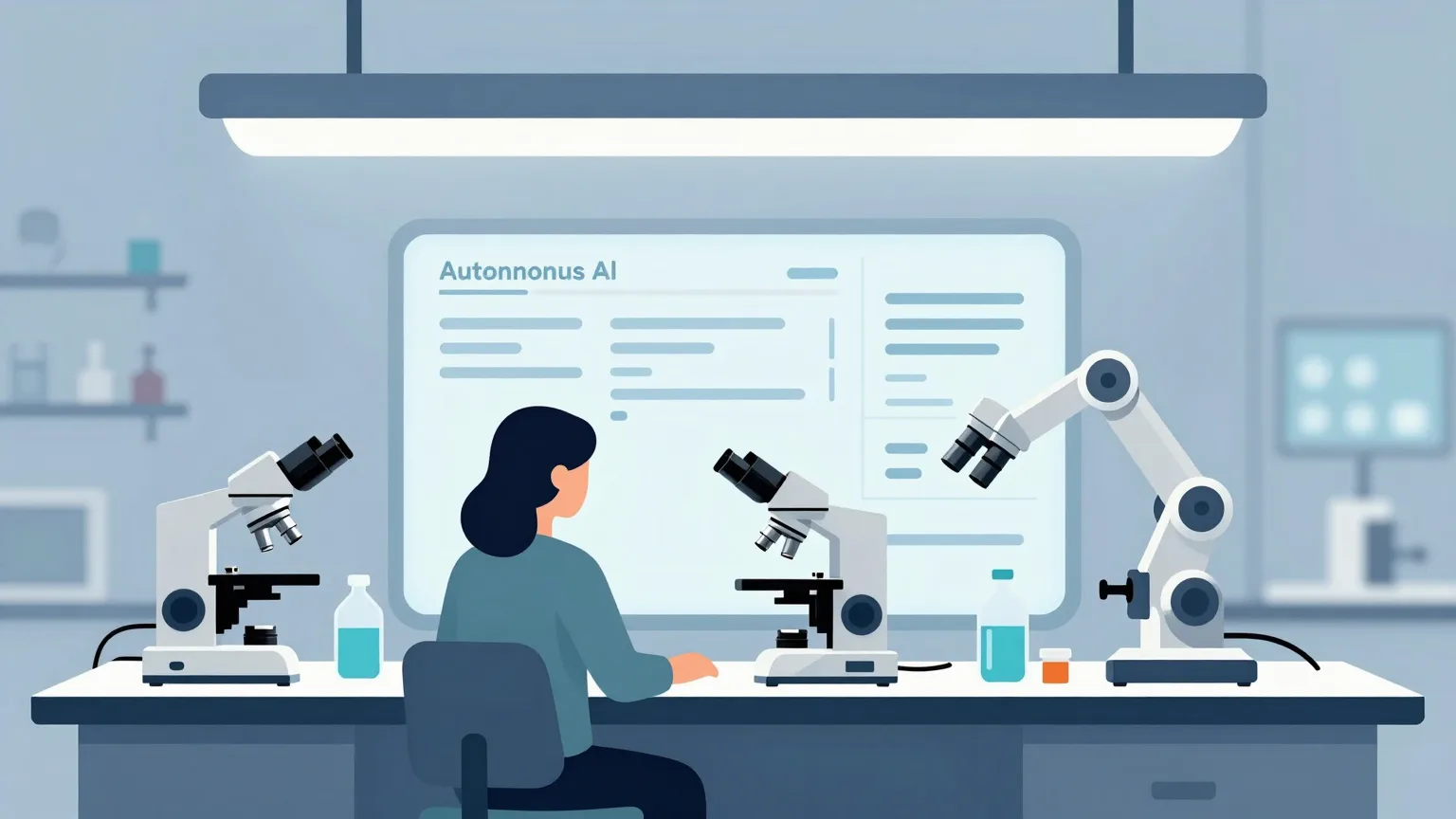
Anthropic has released a research preview of the "Model Hardware Standard" (MHS), a common specification for AI agents to safely operate physical devices, to its first group of partners: scientific research labs and advanced manufacturing companies. The target devices include microscopes, liquid handlers, and robotic arms, with the expectation that agents will operate multiple pieces of lab and manufacturing equipment in parallel, handling everything from routine drug discovery experiments to laser calibration for quantum computers.
The background here is the difficulty of integrating lab equipment. Each device ships with its own programming interface and none of them talk to each other, so specialists previously had to build custom integrations one by one, typically taking weeks to months. MHS reportedly shrinks that integration work down to hours or even minutes. Mechanically, it introduces standard drivers that translate between the OS and the hardware, letting any device be operated through simple primitives like "read" (fetch the temperature) and "write" (set the temperature). It works with anything that has a programmable interface, is model-agnostic, and can be accessed from any agent harness via standard protocols such as MCP (Model Context Protocol).
MHS development grew out of a collaboration between Anthropic and the Janelia Research Campus of the US Howard Hughes Medical Institute (HHMI). The company says it will build safety evaluations and best practices together with partners across science, robotics, electronics, and manufacturing before open-sourcing the standard. As a stepping stone toward an era in which agents move beyond chat and code to operate equipment in the physical world, this is an announcement whose cross-industry impact will be worth watching.
Also Announced: Free Claude for 10,000 Scientists — "AI for Science" Expands Too
At the same time, Anthropic dramatically expanded its support programs for scientists. It will provide 10,000 scientists around the world with Claude subscriptions for one year, free of charge (standard seats) or at a discounted rate (premium seats with 5x usage limits at $15/month), through its newly launched "Claude Team Plan for Scientists." The program targets PIs (lab directors and the like) at academic and nonprofit research institutions and their labs, with plans to scale well beyond 10,000 people over the coming months.
The "AI for Science" program, which provides free credits for high-impact research, is expanding as well. It has mainly supported the biological sciences so far, but will now widen its scope to other fields, such as large-scale computational research including advances on the Riemann zeta function and protein design, granting up to $50,000 in credits per project. Note that biology and chemistry researchers will, for the time being, only be offered Opus-class models, while the lightweight Fable model continues to block specialized biology and drug discovery queries. A life sciences access program run in partnership with the US government has also just launched, suggesting a stance of proceeding carefully with security-conscious permission design.
"How to Contain Claude" — 93% of Permission Prompts Get Approved
Anthropic's engineering blog has published a long-form article, "How we contain Claude across products," detailing the realities of Claude's permission management. Access grants that twelve months ago would have been rejected as "could take down internal services" are now routine, and developer productivity has gone up as a result. Risk is framed along two factors: "likelihood of failure" and "blast radius." The former has steadily declined thanks to safety measures and model training, while the latter keeps growing as capabilities and access expand. The engineering challenge, the article argues, is "putting a cap on the blast radius."
What's particularly interesting is the disclosure of real-world numbers. Telemetry shows that users approve roughly 93% of Claude Code's permission prompts. The company confirmed "approval fatigue," where users' attention wanes as approvals pile up, and built an auto mode that automates safer approvals — but probabilistic defenses always let something slip through. Hence the article's focus: "containment." Rather than monitoring what an agent does, this approach places boundaries on what an agent can do in the first place, using sandboxes, virtual machines, and egress controls — and the bulk of the company's engineering effort, along with many of its most surprising security failures, is concentrated here, the article says. It also notes that Claude Mythos Preview was a model held back from shipping as of April 2026 because its blast radius was judged too large, and that once defensive capabilities mature, a broad release of a similarly capable model would become appropriate.
CEO Amodei to Meet President Trump One-on-One for the First Time — Over Dinner
According to Bloomberg and other outlets, Anthropic CEO Dario Amodei will sit down to dinner with President Trump on Sunday night. It will be the first private one-on-one meeting between the two, who stand on opposite sides of the AI safety debate. Their relationship has soured over a frustrating contract dispute with the Pentagon earlier this year and the Commerce Department's temporary export restrictions on the company's breakthrough model "Mythos" in June, so where things land is drawing close attention.
That same weekend, Microsoft co-founder Bill Gates told NBC's "Meet the Press" that government safety measures against catastrophic risk would not get in the way of US-China competition. "Every country should adopt safety measures. I completely disagree with people who say 'China won't adopt safety measures,'" he said — a claim that stands in sharp contrast to the Trump administration's largely laissez-faire approach. As the debate over regulation becomes entangled with US-China competition, voices defending safety measures are now starting to emerge from the industry side. On a side note, Amodei even became fodder for a sketch on the hit American show SNL, which introduced the line "AI is the devil and I its maker."
China to Allow Alibaba, ByteDance to Buy Nvidia's New Chips — The Information Reports
According to a report by The Information relayed by Bloomberg, the Chinese government has signaled that it will allow companies such as Alibaba and ByteDance to purchase Nvidia's new chip, the "RTX Pro 5500." The Ministry of Industry and Information Technology recently asked some companies to report their purchase plans for this high-end GPU — released just this month — including quantities and intended uses, and reportedly told some of them it intends to grant approval.
US export controls and China's procurement trends are themes that shape the sheer scale of AI development. If access to high-performance chips actually loosens, the constraints on Chinese players' AI training and inference infrastructure could ease considerably. For now, though, this is reporting based on sources with knowledge of the matter, and we will have to wait for future developments on any formal decision or actual purchases.
Local LLMs: Penalizing "wait," "maybe," and "perhaps" Improves Accuracy; 125B Model Runs at 12-15 tok/s on an M1 Max
Over in Reddit's LocalLLaMA community, two inference-time tricks have been drawing attention. One is a replication of a Meta paper, testing whether applying a logit bias (-2) to tokens that signal "rethinking" — such as "wait," "maybe," and "perhaps" (overthinking markers) — improves the accuracy of Qwen 3.5-4B, verified on 50 problems from MATH-500 across various llama.cpp quantizations. It's an attempt to check whether the approach of keeping models from falling into self-correction loops also holds up in quantized environments.
The other is a report from the author of the inference engine "MoEspresso," who ran Qwen3.8-Flash-Next (a 125B MoE model) on a 2021 M1 Max (32GB unified memory) at decode speeds of 12-15 tokens per second. The key is a routing technique called "Cache-Prior," which biases toward experts already resident in memory, combined with heavily compressed quantization formats like IQ2_K. On the author's 48-question benchmark, Qwen 3.8 Flash (running on MoEspresso) reportedly scored 84.3%, beating Claude Opus 4.8 xhigh (80.3%) and others. It has drawn attention as a demonstration that low-memory local environments are closing in on powerful hosted models.
AI Agents Account for 55% of Model Development, But Humans Make Over 85% of the Decisions — an Analysis of 769 Tasks
In research covered by The Decoder, a research team analyzed 769 task logs from the process of building their own AI models. They found that AI agents contributed up to 55% of method proposals, while more than 85% of final decisions were made by humans. Moreover, a third of the tasks would never have been attempted at all without AI.
The authors' point that "increased agent activity does not mean increased autonomy" is fascinating as data on how the human role is changing on the front lines of AI development. A division of labor in which the volume production of proposals shifts to agents while selection and judgment stay with humans may well be becoming the standard for development organizations going forward.