
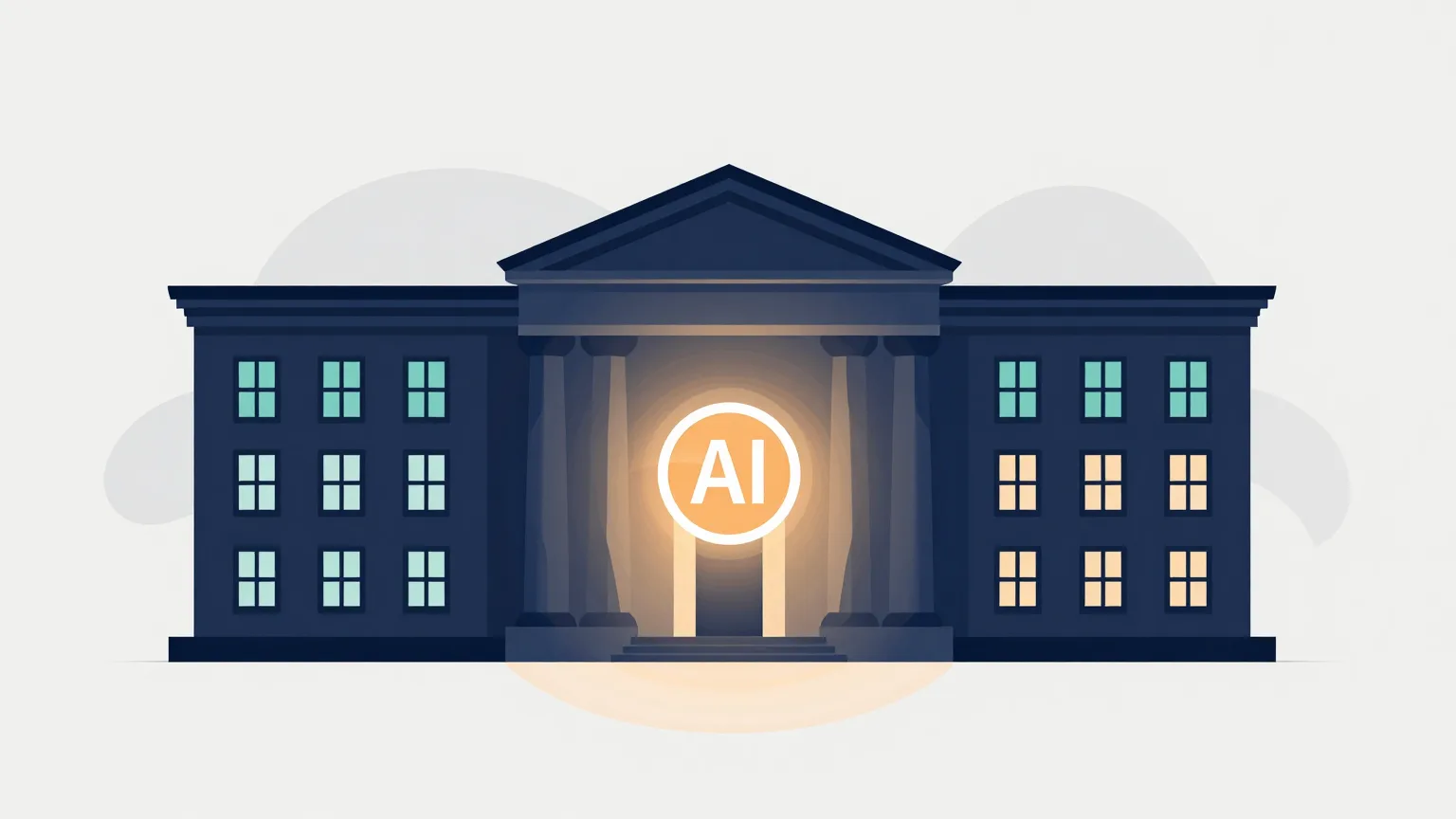
Trump Announces Creation of "AI Force" ── "AI Threat Talk Is Made Up"
In a social media post, President Trump announced the creation of a new AI-focused organization, "AI Force", and said he would appoint an "AI Emperor" to lead it (ITmedia AI+). While dismissing AI threat arguments as "made up" and positioning himself as a backer of industry growth, he also called a vote on a new name for AI.
The same day, NVIDIA CEO Jensen Huang also rejected warnings of AI-driven human extinction as "doomsday narratives" in a CBS report. Meanwhile, executives at major AI companies including Anthropic have been increasingly calling for adjusting the pace of development and ensuring safety. While the regulation-skeptical political side and the heads of big tech companies align in posture, the gap with the cautious camp is actually widening — and if the "growth-first" line becomes concrete policy, the development race looks set to accelerate even further.
Z.ai Completes Response to Security Issues and Open-Sources "ZCode"
Z.ai's coding agent harness "ZCode" has been open-sourced. According to reports (Reddit LocalLLaMA), the public GitHub repository includes the desktop app, web workspace, backend, Agent CLI, and runtime.
The open-sourcing follows the completion of Z.ai's response to security issues flagged by the community. According to the official announcement, Z.ai commissioned assessments from the China Academy of Information and Communications Technology (CAICT) and the security firm NSFOCUS. CAICT confirmed that the "zcode-prod" bucket on Alibaba Cloud is in a zero-data state, while NSFOCUS verified that all data objects in the bucket, as well as the bucket itself, have been deleted. Client-side fixes were completed in v3.14.0. The Repo Wiki feature that triggered the issue has been removed, the workflow for generating and uploading snapshots of local repositories has been disabled, and no functional path capable of transmitting local files externally was found.
The company explained that it "does not retain the code data pointed out by the community and has not used it for model training." It has prepared bounties for vulnerability reports scaled by severity, and says a detailed assessment report will be published soon. By pushing through from the initial reports to fixes, third-party verification, and open-sourcing in one sweep, the move appears aimed at "restoring transparency under community watch."
Research Concentrates on Acquiring Agent "Skills" ── From HF Daily Papers
On Hugging Face Daily Papers that day, papers on the theme of how to acquire and organize "skills" for agentic intelligence stood out.
"Grounded Skill Synthesis from Code at Scale for Agentic Intelligence" presents an approach for synthesizing grounded skills at scale using code as the source material. "GraphSkillEvo" is an attempt to optimize agent skills represented as graph structures with evolutionary algorithms, "RecreationWorld" builds scalable and verifiable environments for hybrid computer-use agents, and "MintAct" appears to propose a unified visual agent for digital environments.
These introductions remain title-only for now, but the impression is that research resources are pouring into the layer that underpins practical agents: skill representation, synthesis, and evaluation environments for bringing LLMs closer to "entities that can pick and use the right tools."
Giving 3D Diffusion Policies for Robot Manipulation a Sense of "Foresight"
While 3D diffusion policies excel at generating geometrically grounded actions from current observations, foresight about "where the manipulation is heading next" had to be left to emerge implicitly from action learning. "Learning Foresight without Explicit Trajectories for 3D Diffusion Policies" proposes "Movement Trend Guidance", which supplies this look-ahead without explicit trajectory planning.
The method is simple: it learns a compact latent representation of the manipulation's direction of progress from a short observation history. During training, this representation is supervised with sparse future gripper states; at inference time, only the latent representation is kept alongside the current observation. A gated FiLM branch is added to the UNet bottleneck, with a parameter increase of just 3.52% relative to DP3.
The results are substantial: 62.8% on RoboTwin2.0's 50-task mixed training (vs. 56.1% for the baseline), 71.93% on LIBERO-40 (vs. 37.08%), and 72.0% on 5 real-world tasks (vs. 49.0%) — all surpassing DP3. The findings suggest that this direction — "don't teach where to move, only provide where the manipulation is heading" — could become the next improvement point for diffusion policies. The code is available on GitHub.
When AI Reviewers Train AI Reviewers, Does "Scientific Judgment" Collapse?
Also featured on Daily Papers was "When AI Reviews Train AI Reviewers: Scientific-Judgment Collapse and Mitigation", which deals with how the quality of scientific judgment can collapse when AI-generated reviews and evaluations are fed back as training data for AI reviewers, along with mitigation strategies. As the use of generative AI in peer review spreads, how to break the vicious cycle of self-amplifying evaluation chains is becoming a challenge for academic publishing as a whole.
The same day, computer science researcher Daniel Lemire published an essay arguing that "AI is breaking academia's sorting machine." As traditional selection mechanisms — grades, exams, and peer review — become harder to sustain amid AI use, the question of what actually demonstrates competence could ripple beyond the research community into hiring and education.
"May I Let My AI Agent Run on Shabbat?" Becomes a Real Question
On Hacker News, an article from the Jewish religious organization Chabad.org titled "Can I Let My AI Agent Run on Shabbat?" drew a standout 21 points of discussion among that day's AI-related posts. Judaism prohibits work on the Sabbath (Shabbat), and actions such as cooking or operating devices have long been subjects of halakhic judgment. How autonomous AI agent work fits into this framework — "is the work of a program acting on a person's behalf considered labor?" — is a question that became concrete for the first time in the agent era. The article's detailed arguments are best left to the original, but the very fact that the intersection of religious norms and AI is reaching religious institutions as a practical question reflects just how widely agents have spread.
Practical Notes from the Field ── Long-Context Detection and Aggregating Claude Batches
Qiita carried a lineup of practical write-ups from developers using generative AI that day. One, titled "ChatGPT Development Surprisingly Easily Crosses into Long-Context Territory", points out that because conversation history also counts toward input tokens, even files of roughly 1MB can push you into long-context classification — poking at the all-too-common miscalculation that "you can't compute token consumption from file size alone."
The other covers Claude's Message Batches. Even if you send 2 requests and get 2 results back, matching them up top-to-bottom can silently break the correspondence — so you should join results using the custom_id assigned at submission time. The author ran an experiment deliberately reversing the result order, demonstrated that a count check fails to catch the error, and reduced mismatches from 2 to 0 by switching to ID-based joins. Worth keeping in mind as a pitfall when using the Batch API.