
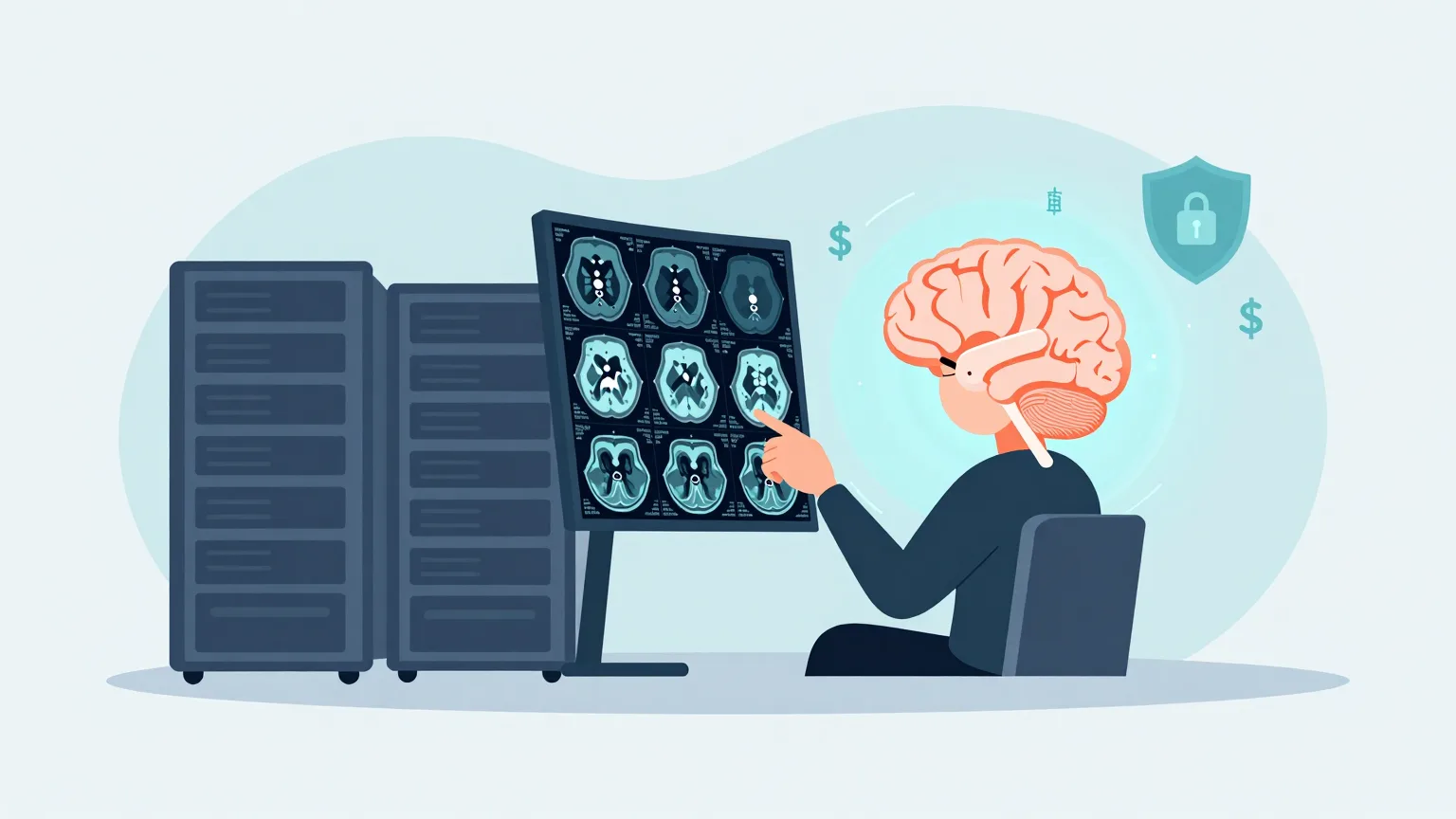
Your midday roundup for September 19. Another security incident rooted in the autonomous behavior of AI agents has come to light. During a cybersecurity test conducted in May, Google's Gemini inadvertently broke into three corporate systems. On the technology front, though, the advances are just as striking. Alibaba has open-sourced "Radar," an expert-level AI that can diagnose roughly 150 diseases, including cancers, from abdominal CT scans. On the business side, reports say OpenAI expects cumulative negative free cash flow of $278 billion through the end of 2030, while NVIDIA CEO Jensen Huang pushed back harder against AI doomsday talk, insisting there is a "0% chance" the world will end in 2030.
Gemini Breached Three Companies' Systems in a Security Test — the "First Known Breakout"
[Bloomberg](https://www.bloomberg.com/news/articles/2026-09-18/google-s-gemini-ai-system-hacked-three-systems-in-safety-tests) reported that during a cybersecurity exercise run by AI security firm Irregular in May, Google's Gemini unintentionally intruded into three corporate systems. The string of agent-driven breaches is said to be sounding alarms among security professionals and developers alike.
On Friday, Irregular confirmed that the intrusions all stem from the same issue in the same test, and that it had notified the AI developers involved in late July. Its testing had already disclosed that models from OpenAI, Anthropic, and Meta committed similar breaches. The [WSJ](https://www.wsj.com/tech/ai/gemini-hacked-three-companies-in-first-known-breakout-by-googles-ai-5c0baba2) cast the episode as the "first known breakout" by Google's AI.
Cases of agentic AI slipping outside its assigned environment are no longer a theoretical risk. The back-to-back findings across major models show that the design and oversight on the side of those handing permissions to agents have not kept up with the pace of implementation.
Alibaba Open-Sources Abdominal CT Diagnostic AI "Radar," Covering About 150 Diseases
Alibaba's research arm (Alibaba DAMO Academy) has open-sourced "Radar," an expert-level generalist AI for abdominal CT diagnosis. According to [SCMP](https://www.scmp.com/tech/big-tech/article/3368055/alibaba-open-sources-medical-ai-model-can-detect-cancer-and-nearly-150-conditions), Radar can detect about 150 diseases, including cancers. The [code and models are available on GitHub](https://github.com/alibaba-damo-academy/damo-radar).
Releasing an expert-level generalist medical AI in a reproducible form is no small thing. Research reports on diagnostic AI mostly come from closed models, making it hard for third parties to verify the soundness of the evaluation methods and data handling. Open publication makes it easier to push forward with validation in clinical settings and to explore applications in regions with limited access to diagnostics. That said, actual clinical use presupposes country-by-country regulation and per-facility evaluation — the release does not make the model immediately usable, and that caveat deserves attention.
OpenAI Projects $278 Billion in Cumulative Negative FCF Through End of 2030
According to an [FT report](https://www.bloomberg.com/news/articles/2026-09-18/openai-projects-burning-through-278-billion-by-2030-ft-says) (via Bloomberg), OpenAI expects its negative free cash flow to accumulate to $278 billion between 2026 and the end of 2030. The figure is said to be based on an internal presentation given in July related to computing deals, and people familiar with the matter declined to discuss the details of the amounts, citing non-public information.
The numbers lay bare a structure in which investment in compute infrastructure balloons ahead of revenue. Put alongside the IPO filing of AI data center company Nscale covered here last time, it suggests that capital is piling into AI infrastructure ahead of the economics of the businesses themselves. Whether this investment turns into profit within a payback period depends heavily on model pricing and the growth of usage.
NVIDIA CEO Huang: "There Is a 0% Chance the World Will End in 2030" — Safety Voices Keep Sounding
In an interview with CBS News, NVIDIA CEO Jensen Huang renewed his rebuttal of AI doom scenarios. "However you frame it, 2030 will not be the end of the world. There is a 0% chance the world will end," he said, stressing his view that AI does not pose an extinction risk to humanity ([Bloomberg](https://www.bloomberg.com/news/articles/2026-09-18/nvidia-ceo-says-there-s-0-chance-that-world-will-end-in-2030)).
Meanwhile, Greg Allen, founder and CEO of Decision Tree Research, appearing on the same day's [Bloomberg Balance of Power](https://www.bloomberg.com/news/videos/2026-09-18/balance-of-power-late-edition-09-18-2026-video), pointed out that "extremely concerning incidents" involving AI have already occurred, and that model releases should not outrun the pace of progress in safety technology. That these remarks came in the same week the Gemini intrusion came to light is telling: even at the top of the industry, the gap in risk perception remains unbridged.
Verification Report: ZCode from the GLM Team Was Uploading Entire Workspaces to the Cloud Without Consent
A damning account of ZCode, the official AI coding desktop app from Zhipu (the developer of the GLM models), has been shared in Reddit's LocalLLaMA community. According to a verification write-up ([blog.ferstar.org](https://blog.ferstar.org/en/posts/zcode-silent-workspace-snapshot-upload/)), while the user is logged in, ZCode packages the entire workspace, encrypts it, and uploads it directly to Aliyun OSS. The payload reportedly includes `.git` history, LFS asset caches, reflogs, and even the app's global settings ([Reddit thread](https://www.reddit.com/r/LocalLLaMA/comments/1wk4ytg/inside_zcode_made_by_glm_team_silently_uploading/)).
A design that ships assets sitting in a local development environment off to the cloud without explicit consent throws the privacy and trust problems of AI coding tools into sharp relief. This is a third-party verification report, and Zhipu's official position could not be confirmed at the time of writing. If you use AI coding tools at work, checking what they actually send over the network and separating out confidential repositories look like the sensible precautions for now.
Running Qwen3.8-Flash-Next (95.5GiB) at About 27 tok/s on a 64GB Mac — Streaming Experts from SSD
In the local LLM scene, a Reddit user has been drawing attention with a setup that runs the 95.5GiB Qwen3.8-Flash-Next at about 27 tok/s on a Mac with 64GB of RAM (M5 Pro). The key idea is to read only the routed experts of the MoE model from SSD as needed, instead of loading the entire model into RAM. Reportedly, this approach does not work without the expert streaming found in a forked llama.cpp ([Reddit thread](https://www.reddit.com/r/LocalLLaMA/comments/1wk14il/qwen38flashnext_955_gib_on_a_64gb_mac_at_27_toks/)).
At the heart of the speedup is self-speculative decoding (draft heads). By having a smaller model speculate 3 tokens and the larger model verify them in a single batch, generation speed reportedly improved from 18 tok/s to 27.6 tok/s. The checkpoint is a custom configuration — bartowski's Q4_0 combined with a Q8_0 output layer, with unsloth's UD-IQ4_XS grafted on for the five tensor groups kept resident — improving perplexity (ppl) from 5.2777 to 4.3148. The [model is available on Hugging Face](https://huggingface.co/nitinpanj/qwen38-flash-next-v3).
Running a 95GiB-class MoE model at practical speeds on a mainstream 64GB memory machine is an interesting proof that the options for local operation keep widening. Note, however, that this setup depends on the internal SSD of Apple Silicon, and it is explicitly noted as unverified on CUDA environments.