
From September 12's AI news: a roundup centered on a forecasting model that factors in future events, the legal risks of always-listening AI, and a new long-context open model.
Google's TimesFM-3 Predicts the Future in One Pass, Folding in Weather and Sale Schedules
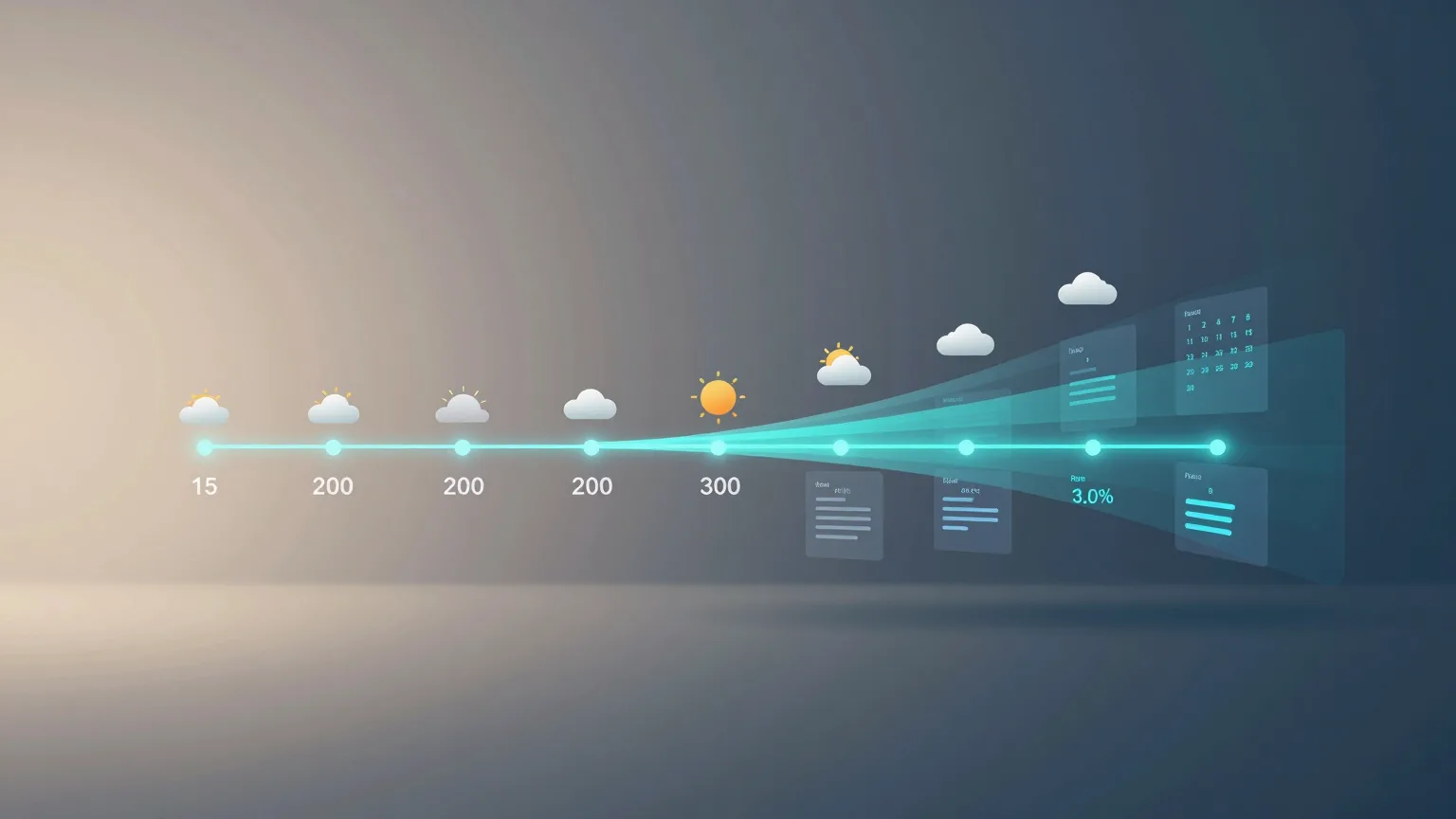
Google Research has released [TimesFM-3](https://the-decoder.com/googles-new-ai-model-predicts-the-future-from-sales-data-weather-and-discount-schedules/), a next-generation time series forecasting model. Its key feature is that, in addition to time series like sales data, it can fold "future events we already know about"—such as promotional schedules and weather forecasts—into its predictions.
Conventional time series models mostly predict the future one step at a time, and errors tend to pile up as forecasts stack. TimesFM-3 is a 330-million-parameter model that fills in all future time points in a single inference pass, combining reduced computation time with lower compounding error.
Take retail as an example: information known in advance—like "there's a discount sale next week" or "it will rain this weekend"—can be used as input. Since this should yield demand forecasts closer to reality than simple extrapolation of past patterns, the model is expected to find use in areas where events sharply change the outlook, such as inventory optimization and energy supply and demand.
Apple Watch's Always-Listening AI Puts Eavesdropping Laws at the Center of Debate
The new AI features Apple announced for the Apple Watch Series 12 and Ultra 4 are raising legal questions. Legal experts note that these always-listening features could become a test case for eavesdropping laws.
Two features are at issue. Siri Recap generates summaries of the conversations a user had that day. Live Rewind transcribes and displays the last 15 seconds of a conversation, and can be invoked by double-pressing the watch's crown.
In exchange for convenience, with the recording of conversations becoming the norm, how far this remains legal looks likely to stay unclear for the time being.
Agnes-3.0-Flash: A 33B Model Handling 260K Tokens, with Global Attention on Only One in Four Layers
From the open-weights camp, [Agnes-3.0-Flash](https://huggingface.co/Agnes-AI/Agnes-3.0-Flash), a multimodal 33B model, has been released and is attracting attention in the LocalLLaMA community.
The highlight is its hybrid attention design. Of its 72 layers, 54 are recurrent layers using what's known as the "gated delta rule," holding state that doesn't depend on sequence length. Only the remaining 18 layers have standard global attention; this design keeps the oft-bloated KV cache down to 18 layers while securing a context length of 262,144 tokens.
It supports understanding of text, images, and video, along with tool calling and adjustable reasoning effort. Its Artificial Analysis score is 36, and while the site currently displays it as a "proprietary model," the weights are in fact openly available.
Other Topics
The Guardian reported that UK data suggests AI may be weakening the job prospects of computer science graduates.
Reuters, citing people familiar with the matter, reported that the UAE—recently attacked by Iran—is revising its plan to build a 5GW-class AI data center.
Japan Pickup: Splitting Summarization Between Haiku and Sonnet Brought More "Things to Verify" Than Savings
An engineer who maintains a workflow of summarizing YouTube lecture subtitles into Obsidian notes with Claude Code has published a [hands-on write-up](https://zenn.dev/camomile_cafe/articles/a815d10eab4705) of rethinking how the work is divided, prompted by videos over 10 hours long whose subtitles run 500,000–700,000 characters.
The approach: leave the job of reading the source text to Haiku, which has a lower API price, and hand the shortened partial summaries to Sonnet to compile into the final note. The cost savings were achieved, but a side effect emerged—the list of items to verify actually grew. Tracking the cost and quality trade-offs of dividing labor across models with real measurements, the piece is a useful reference for anyone designing long-form content processing.