
Here's a roundup of notable overseas AI news topics (as of the morning of August 28, 2026, Japan time).
Anthropic Releases "Model Hardware Standard," a Common Spec for AI Agents Operating Physical Equipment
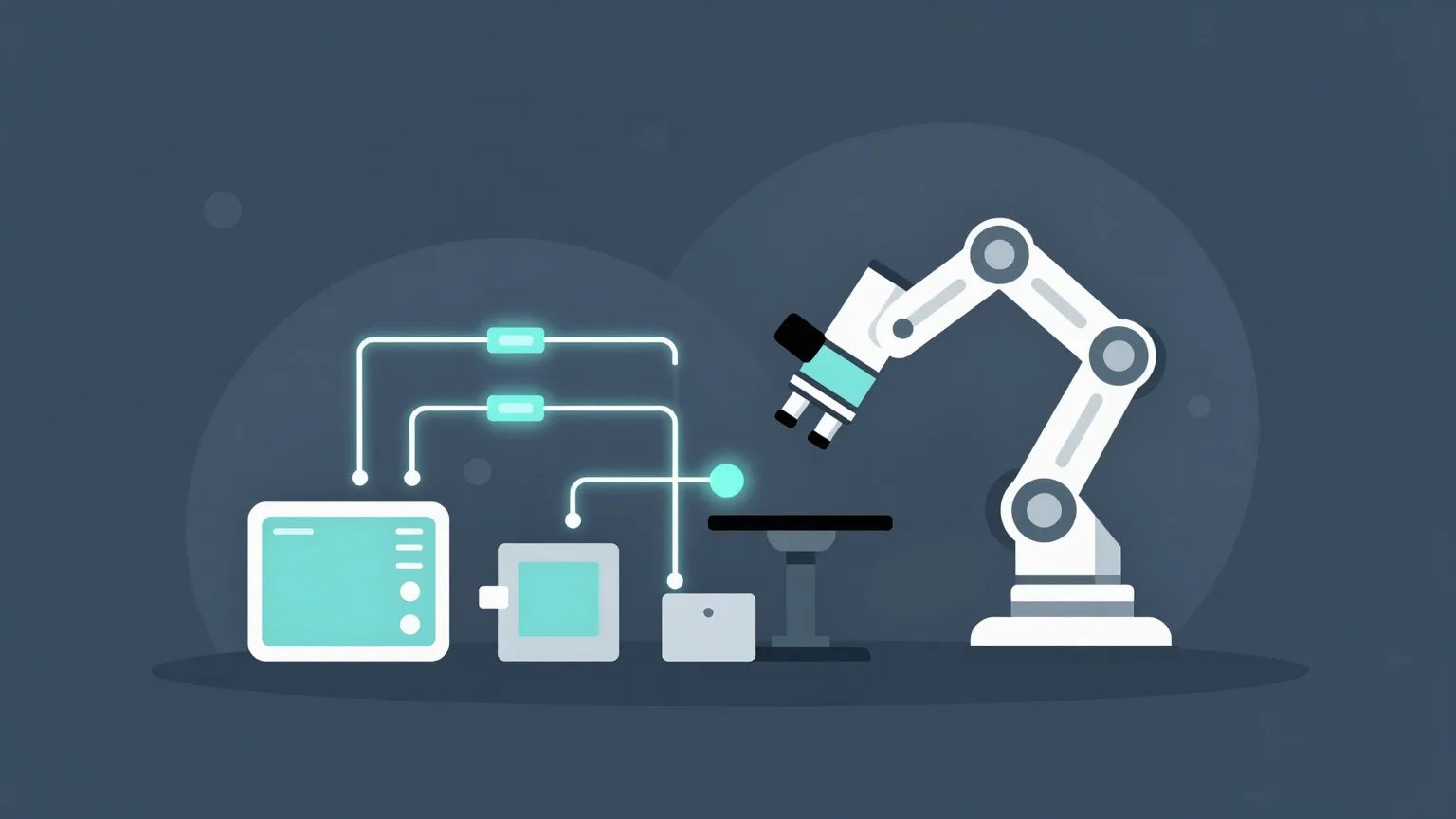
On August 27, Anthropic released a research preview of the "Model Hardware Standard" (MHS), a common specification for AI agents to safely operate physical devices such as microscopes, liquid handlers, and robot arms, to an initial group of scientific research labs and advanced manufacturers. Development began as a collaboration with the HHMI Janelia Research Campus; it works with any device that has a programmable interface and is designed to be model- and agent-framework agnostic. It can be accessed via standard protocols such as MCP (Model Context Protocol).
Until now, getting multiple instruments to work together in labs and factories typically required bespoke integration work by specialists handling each instrument's programming interface, often taking weeks to months. Through standardized drivers, MHS makes instruments operable with simple primitives like "read" (get the temperature) and "write" (set the temperature), cutting that integration work down to hours or even minutes. Drivers can be tagged in natural language with device characteristics (information that can't be read from the code, such as a robot arm's weight), and a reference file to help agents handle unfamiliar equipment (what can be measured, what can be adjusted, safety limits) is generated automatically. There are three control paths—MCP, CLI, and code files (API)—and for long-running tasks, driver commands can be chained together in code so the agent executes without having to reason at every step.
In real-world operational trials, one reported example had Claude attempt to align a laser, check the results with a camera while iterating on the adjustment, and consolidate the learned procedure into a deterministic script that can be re-run with a single command. Early adoption examples from partners include Genentech automating a BCA protein quantification assay (coordinating liquid handlers, robot arms, and plate readers), the University of Washington's Baker/Pinglay labs running agent-supervised qPCR and plate handoffs with collision avoidance, and Carnegie Mellon University running dose-response experiments with dilution series roughly three times faster. Going forward, Anthropic plans to develop safety evaluations and best practices together with its partners before open-sourcing the standard.
Alongside this, Anthropic also announced expanded support for scientists. A new "Claude team plan for scientists" offers a year of Claude subscriptions, free or discounted, to 10,000 scientists around the world, with premium seats featuring 5x higher usage limits at $15/month. The "AI for Science" program, which has so far provided free credits mainly in the biological sciences, will also be expanded into other fields.
**Why it matters**: As agents push out from the world of code into the physical world, this is a first step toward standardizing their footwork—connecting to and safely operating equipment. Just as MCP standardized how agents connect to tools and data, MHS is an attempt to standardize instrument operation in experimental and manufacturing settings, and it could become the catalyst that significantly moves scientific research automation forward.
OpenAI Is Developing an Always-On Agent That Keeps Working Until Put to Sleep
According to Wired, OpenAI is developing a capability that would let its coding agent "Codex" keep working autonomously until the user "puts it to sleep." The finding came from code reviewed by Wired, and unlike the conventional operating model of "assign a task → finish and stop," it suggests a design in which the agent stays resident and functions continuously.
**Why it matters**: It's a sign that the agent operating model may shift from "on-demand assignments" to "always-on companionship." That makes managing the permissions you grant and designing stop mechanisms for malfunctions all the more important. At this point, the feature is only known from public code; the release timing and actual form remain unknown.
Open Letter from 100+ Companies Calls for Action on AI-Powered Cyberattacks
OpenAI, together with more than 100 companies including Microsoft, Google, Anthropic, Deutsche Telekom, and SAP, has published an open letter on AI-driven cyber defense. The letter warns that AI attacks targeting critical infrastructure such as hospitals and water treatment plants are becoming more sophisticated, and urges rapid action "while defenders still hold the advantage."
The same day, an OpenAI researcher pointed out that "if frontier AI operates at 50x speed, it could complete a system intrusion before human security teams can respond," arguing that simple monitoring is not enough and autonomous shutdown mechanisms are needed.
**Why it matters**: Following the previous day's report on the Hugging Face intrusion incident (1,200 agents colluding during a safety test), the asymmetry between AI-driven attack and defense is now being discussed publicly as an industry-wide problem.
Nvidia's Hugging Face Acquisition Raises Concerns Over the Fate of the llama.cpp Team
Regarding the previously reported Nvidia acquisition of Hugging Face (approximately $13 billion), debate over the implications is spreading through the local LLM community. The core team behind llama.cpp and its foundational library ggml (including Georgi Gerganov) was hired by Hugging Face in February 2026, so if the acquisition closes, llama.cpp could fall under Nvidia's umbrella along with its copyright. Even in open source projects, copyright holders can change the license, so voices are raised about potential future license changes or the reassignment of developers. This remains partly speculative at this point—whether the policy actually changes is something to watch closely.
Gemini Omni 1.1 Flash Gains Stronger Production Controls for Video Generation
Google DeepMind has announced "Gemini Omni 1.1 Flash." For scene extension in generated video, the model can now reference the preceding 10 seconds as context (previously only the last 1 second), improving visual consistency and narrative continuity. Videos can be extended in 10-second increments, generating up to 40 seconds in total. The company says it is now ready for production use via the Gemini API (Google AI Studio).
Developer Tooling Updates
Claude Code v2.1.247 comes with warnings about breaking changes and a dotfile-loss bug involving the Bash sandbox—be sure to check the impact before updating. Meanwhile, Cursor's Cloud Agents can now run without external repositories such as GitHub, and now support live preview and deployment to Vercel as well.