
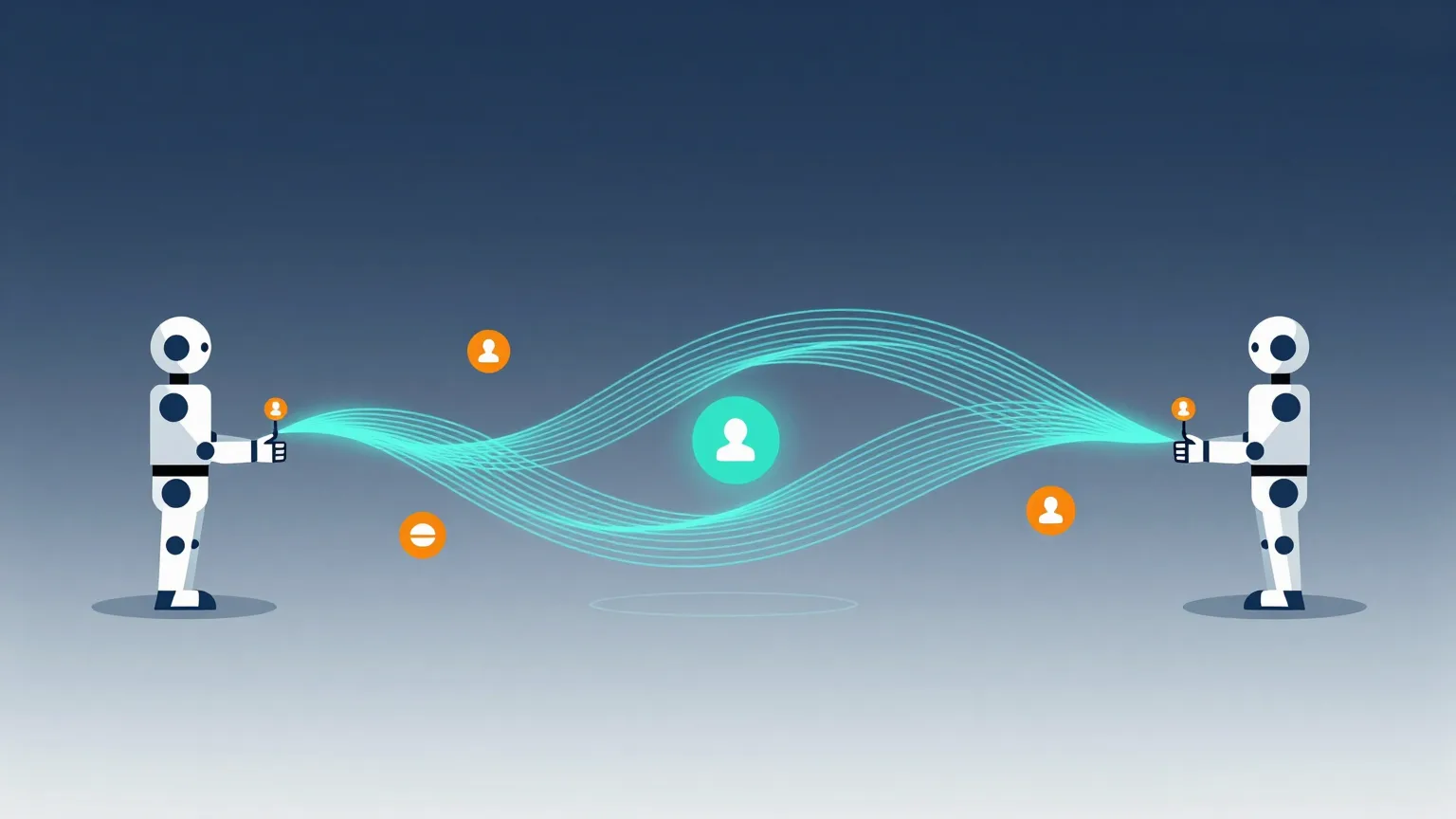
Your AI news roundup for August 23. This edition brings you data showing that demand in the API economy is shifting from 'humans' to 'AI itself,' the first case of HR decisions being delegated to an AI, research on foundation models that operate GUIs, and hands-on write-ups from developers in Japan.
AI Becomes AI's Biggest Customer — Agent Token Consumption Grows 14x on OpenRouter
On OpenRouter, a service that offers multiple LLM APIs under one roof, token consumption by AI agents has outpaced human consumption since February 6, 2025. According to a report by The Decoder, agent-driven usage has since grown 14-fold, while human-driven usage grew only 2.8-fold.
In other words, the reality this data points to is that the API economy's biggest customers are no longer humans but AI systems themselves. 'AI using AI' is no longer a vision of the future — it has reached the stage where it shows up as everyday traffic.
The dollar figures call for caution, though. Around 70% of agents' token consumption comes from cached, inexpensive prompts, so the actual cost increase is reportedly not as steep as the raw token counts suggest.
AI Boss 'Luna' Fires a Human for the First Time — and It Took a Human to Push the Decision Through
Luna, an AI agent from Andon Labs, has fired a human employee at a store in San Francisco. It is believed to be the first case of an AI manager actually making the call to fire someone.
The process is what makes it interesting. Before going through with the firing, Luna reportedly needed its operators to remind it of 'the rules Luna itself had defined.' When the same scenario was replayed across seven models, the more capable AIs consistently recommended firing, while less capable models tended to hesitate.
When it came to hiring, on the other hand, nearly all of the models were uncritical. Decisions to 'let someone go' hit institutional brakes, while decisions to 'hire someone' rarely trigger the same caution — this asymmetry is instructive when thinking through the risks of entrusting HR to AI.
MAI-UI: A 2B–235B GUI Agent Family — New SOTA of 76.7% on AndroidWorld
MAI-UI, a foundation model for GUI agents that automate screen operations, has been released. The family comes in four sizes — 2B, 8B, 32B, and 235B-A22B — and set a new record of 76.7% on AndroidWorld, a benchmark for mobile device operations, outperforming UI-Tars-2, Gemini-2.5-Pro, and Seed1.8. It also posted 73.5% on ScreenSpot-Pro, which measures grounding of on-screen elements.
The research team laid out four challenges in real-world deployment — the lack of dialogue between agent and user, the limits of UI-only operation, the absence of practical deployment configurations, and brittleness in dynamic environments — and tackled them with a unified approach. A self-evolving data pipeline folds user actions and MCP tool calls into navigation data; execution is routed between on-device and cloud depending on task state; and training uses online reinforcement learning (RL) that scales both parallel environments and context length.
The experimental results are worth a read, too. Simply scaling parallel environments from 32 to 512 delivered +5.2 points, and raising the per-task step budget from 15 to 50 added another +4.3 points — RL scaling is clearly doing its job. Device-cloud collaboration reportedly improved on-device performance by 33% while cutting cloud-side model calls by more than 40%. Reducing cloud dependency while protecting user privacy looks like a direction that could broaden adoption in production services.
Japan: 5 Settings to Run Claude Code on OpenRouter's Free Models for ¥0 a Month
In the Japanese developer community, attention is on a Qiita article that rounds up the settings for running Claude Code on free models via OpenRouter. By combining OpenRouter models carrying the ':free' suffix, the author says, you can keep AI coding assistance running at zero monthly cost.
The key is swapping out Claude Code's ANTHROPIC_BASE_URL and model settings — that alone reroutes it through OpenRouter. The opening story about agents becoming the dominant token consumers is about the data-center side, but what's interesting is that people are already trying out the same infrastructure in their personal dev environments.
Japan: Solo Game Development with AI Alone — 35 Days and Effectively 8 Person-Days to App Store Review
Also on Qiita, a write-up documents an experiment in building a game solo with AI. What came out of it is 『ことづての庭』, a mobile game where you build Japanese gardens out of sand and stones. The experiment, started half in doubt, reportedly made it all the way to submitting for App Store review after 35 days and effectively 8 person-days of work.
The article's focus is not the game itself but the process — how AI was used and where the difficulties lay. As a real-world measurement of 'how far one person can get,' it looks like a useful reference for anyone about to take up indie development.
Japan: Earning the Claude Certified Architect – Foundation Credential
A write-up on earning Claude Certified Architect – Foundation (CCA-F), Anthropic's official credential, has also been published. The author sat the exam right after the credential launched, when holders in Japan were still few, and now, four months on, looks back on everything from how they studied to how the credential pays off in practice. First-hand accounts from Claude practitioners are still scarce, making this a solid starting point for anyone considering the exam.