
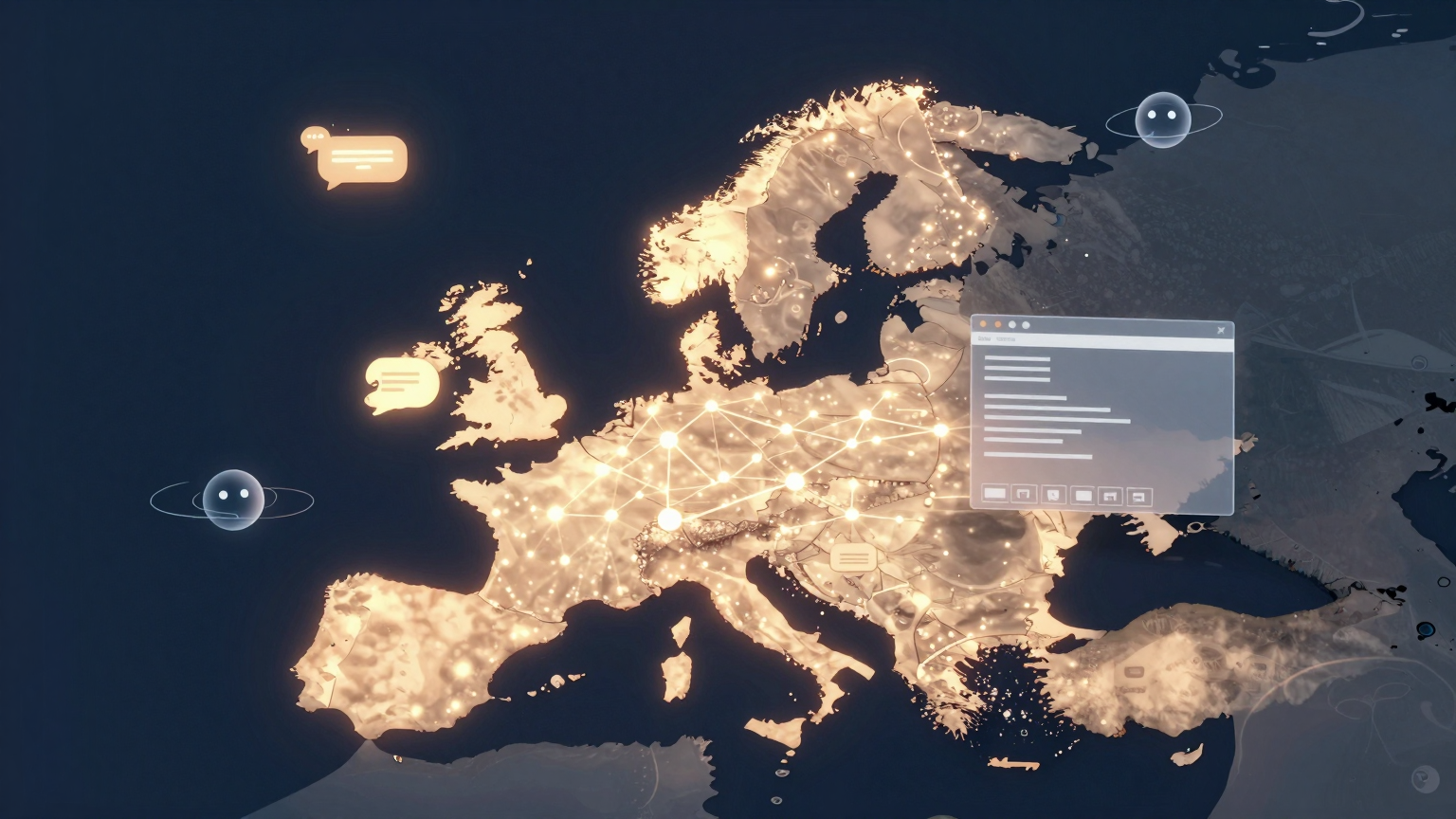
OpenAI has expanded ChatGPT ads to 31 European markets. Here are six of the most important stories from the AI news collected on August 19, including research showing that benchmark accuracy can be lifted by scaling an agent's "plumbing" rather than the model itself, Notion's published design for shared agent memory, and an Economist analysis examining AI's impact on children's learning.
ChatGPT Ads Expand to 31 European Markets
OpenAI has officially announced that ChatGPT Ads is expanding to 31 European markets. The positioning is that advertisers can reach users as they explore information, compare options, and make decisions — a full-scale rollout of a new framework for delivering ads aligned with the conversational context.
Japan was reportedly added to the list of target countries just recently, and with this European expansion the regions covered by the advertising model have grown considerably. Unlike search-linked ads, this format inserts ads "mid-conversation and mid-decision," which makes delivery design substantially different from what advertisers are used to. As ad placements multiply, the judgment of which ad to show in which context will bear directly on the user experience.
95.3% on Terminal-Bench 2.1 Through Harness Scaling Alone — StateM
Research titled "StateM," published on Papers with Code, reports lifting agent performance by scaling the harness rather than the model. According to its title, harness scaling achieved Raw Accuracy of 95.3% on Terminal-Bench 2.1, a benchmark for terminal work — the equivalent of a "frontier run" at $15.
The detailed methodology could not be confirmed at the time of collection, but the implications are significant. An agent's results are not determined by the model's intelligence alone; they swing widely depending on how the surrounding design (the harness) — tool calls, retries, and the like — is put together and how far it is scaled. Compared with the cost of swapping out models, harness improvements are a relatively cheap area to experiment in. If the "$15 frontier run" phrasing is accurate, this could become an example signaling that the focus of performance chasing is shifting from model selection to the design of the plumbing.
Notion Publishes Its Design for "Shared Memory" for AI Agents
Notion has published an article titled "Building Shared Memory for AI Agents in Notion," which was also picked up on Hacker News. It appears to be a technical write-up covering how to build shared memory — enabling multiple AI agents to coordinate by referencing the same knowledge base — on top of Notion's existing mechanisms.
How to share state and knowledge across agents is a classic pain point when running multi-agent setups in production. Using Notion, with its documents and databases, as the foundation could be an easier way to get started than building a proprietary memory layer. The article's detailed contents were not included in the collected data, so for now this remains an outline-level introduction.
Does AI Stop Children from Learning? — The Economist's Analysis
The Economist published an article titled "Does AI stop children from learning?" in its graphic-detail series, which handles data visualization. The piece looks at the impact of AI's spread into education on learning through data, and it has also been drawing responses on Hacker News.
Debate over AI's effect on learning continues, with voices saying it helps efficiency standing alongside concerns that it robs children of opportunities to think. The details of the conclusions could not be confirmed at the time of collection, but the very continuation of efforts to examine educational impact with data rather than intuition will, little by little, furnish the material needed for adoption decisions.
Even Agents That Pass Verification Break When They Form a "Herd"
A technical article on Zenn takes the discussion of agent-operation risks one level deeper. The author has long argued, through a concept called the "verifiability staircase," that the bottleneck in running agents is verification design, not model intelligence. The idea: rank tasks into tiers by verification cost rather than generation cost, and misjudging which tier a task sits on is what causes incidents.
But in August 2026, two events reportedly occurred that expose the wall one step above. One is Anthropic research showing that even agents that are individually harmless — that is, each output passes the staircase's verification — break systematically when many of them interact. The other is an incident that OpenAI reportedly disclosed at the security conference Black Hat USA 2026. The point: no matter how carefully outputs are verified one by one, there is a new dimension of failure in which the way systems are deployed does the breaking.
Even if an agent passes quality checks as a standalone unit and is deemed safe, the moment it is deployed in numbers, its interactions create a new failure surface. For systems that scale up agent counts, this kind of risk — one that unit tests cannot catch — will likely need to be factored in at the design stage.
The "Numerical Mismatch" That Quietly Breaks RL Post-Training
Another Zenn article explains a numerical mismatch that quietly wrecks RL post-training (the process of further tuning a trained model with reinforcement learning).
An inference engine that generates responses and a training engine that updates weights can produce slightly different numbers for the same tokens even when they hold identical weights. This gap — which breaks the assumption that "the same weights should produce the same probabilities" — is called "mis_kl," and when the conditions align it accumulates and collapses training. Using GRPO (Group Relative Policy Optimization) as an example, the article maps out where this gap is born, what amplifies it, and how it can be suppressed.
The nasty part is that nothing surfaces as an error; only the training results quietly degrade. That makes it a point that cannot be ignored in modern RL pipelines that mix inference engines and training frameworks. When tuning a model with reinforcement learning, it seems a step is needed to verify numerical reproducibility itself, not just the accuracy figures.