

In an era when AI can replicate ten years of effort in minutes, how does the value of technical skill change?
The conclusion first: the evolution of AI will not eliminate the value of human technical skill. What changes is where that value is placed. Skills that have traditionally been used 'to create deliverables with our own hands' will now also be used 'to evaluate, correct, and make final judgments on what AI produces.'
Programming, illustration, design, music, writing. All of them once required years of training before you could deliver work above a certain standard. Now, with AI, even beginners can produce output at a reasonable level in a short time. Someone who started yesterday can use AI to replicate in minutes the skills it took you ten years to build—feeling a hollow sense of loss at this situation is a perfectly natural reaction.
This article does not tell the simplistic story of 'will AI take our jobs?' While acknowledging the benefits of AI-driven democratization of skills, it squarely addresses the inner conflict that those who have spent years of effort tend to feel, and follows where the value of human technical skill is moving, with concrete changes in each industry.
To state the direction of the conclusion up front: this is not a pessimistic one. Human value will not disappear; the places where that value is exercised will change. Let's confirm the overall picture of this change through real examples from each industry.
The Changes Actually Underway in Programming, Illustration, and Music
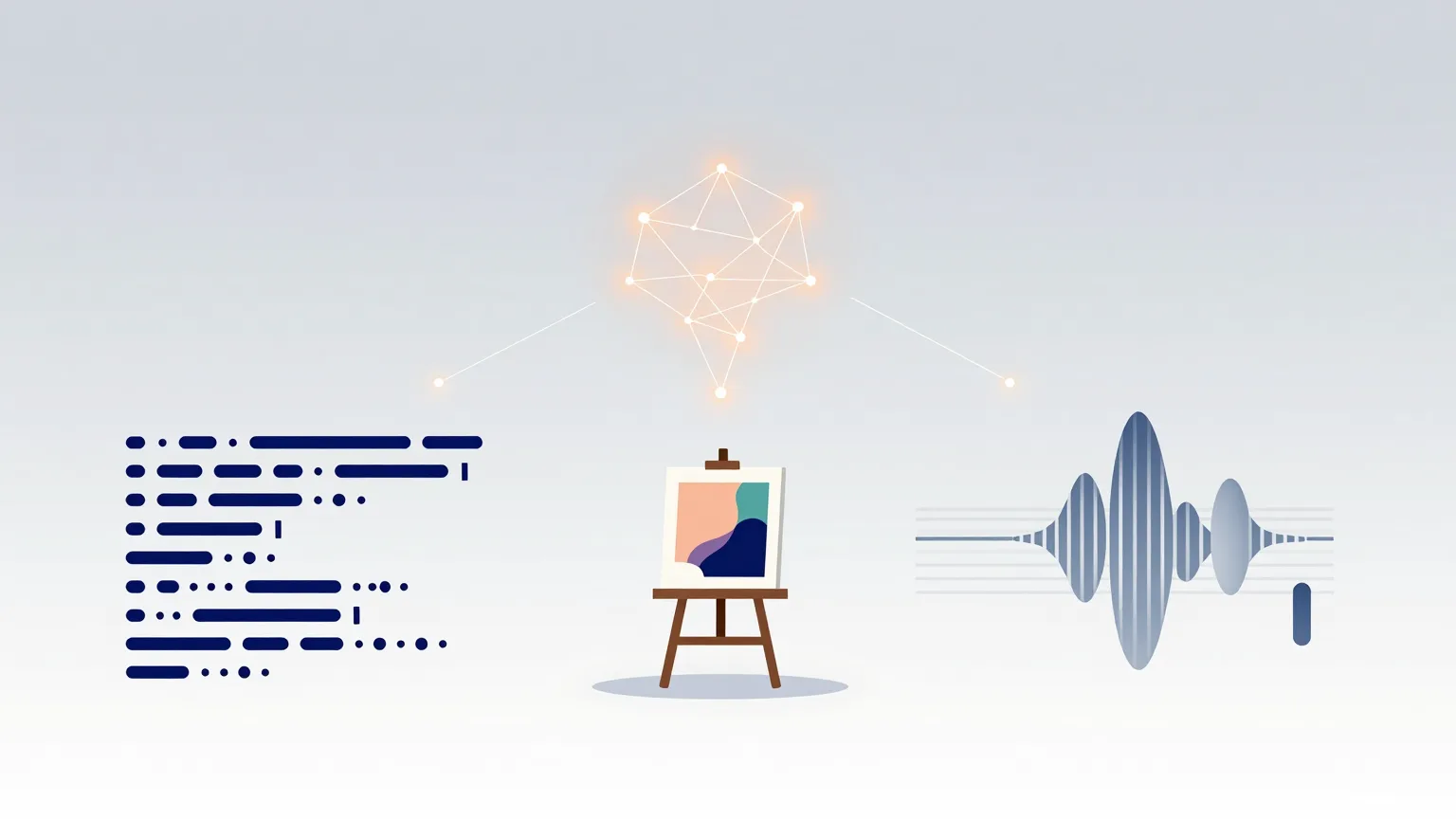
These three fields share a common structure: AI has drastically lowered the barrier to entry, letting beginners produce results at a certain level, while experts retain a new role—'judging the quality of output and taking responsibility to the very end.' Let's start by looking at the specifics in each field.
Programming: From 'Person Who Writes Code' to 'Person Who Makes the System Work'
In programming, AI has dramatically lowered the barrier to writing code. Things that previously could not be built without first learning a language, a framework, libraries, and error handling can now be implemented to a considerable extent with instructions in natural language alone.
On the other hand, the problem is equally clear: there is a growing amount of 'code that runs but is not understood.' For example, a function like the following that reads a configuration file is a typical case.
import json

def read_config(path):
    with open(path) as f:
        return json.load(f)
This function throws an exception and stops when the file does not exist, when the JSON is corrupted, or when read permission is missing. If the one attempt you tried happens to succeed, it looks like it 'works,' but this is code that will suddenly die in production. AI-generated code is riddled with cases like this: missing exception handling, overlooked security issues, additions made without any thought for future maintainability. If development proceeds without being able to judge whether the output is correct, technical debt accumulates in invisible form.
Furthermore, there is concern about changes in how experience is gained: the joy of solving complex problems with your own hands fades, and junior engineers lose opportunities to learn the fundamentals through trial and error.
On top of that, the value of engineers shifts from 'being able to write large amounts of code' to overall system design, technology selection, requirements definition, security, exception design, guaranteeing maintainability, reviewing AI-generated code, and taking responsibility for final quality. In a word, it is a shift from 'person who writes code' to 'person who makes the system work.'
Illustration and Design: From 'the Ability to Draw' to 'the Ability to Choose, Correct, and Set Direction'
Achieving high drawing skill required studying many techniques over a long period: sketching, composition, color, human anatomy, light, and material rendering. Image generation AI has changed this premise, enabling people who cannot draw to produce high-quality images in minutes. The longer someone has been drawing, the more likely they are to feel that hollow sense of 'what were all those years of effort for?'
But being able to generate images with AI and being able to create good images are two different things. An experienced person can instantly spot problems in AI output: 'the composition is weak,' 'the anatomy is off,' 'the visual flow is unnatural,' 'the lighting direction is broken,' 'the color balance is poor,' 'the intended emotion doesn't come across.' What comes into play here is not just the ability to draw, but the ability to choose, the ability to correct, and the ability to set direction.
Also, as polished images circulate in massive quantities, human qualities—imperfection, idiosyncrasy, the creator's unique expression, rawness, and the backstory of the work—may conversely gain value.
Music and DTM: From the Polish of the Sound to 'Who Made It, and Why'
Music follows the same structure. Even if you cannot play an instrument, read sheet music, or know theory, you can now use AI to produce tracks above a certain standard. The drastic lowering of the barrier to music production is clear progress in terms of democratization.
On the other hand, once anyone can produce music in large quantities, 'pretty tracks' and 'well-crafted tracks' are no longer scarce in themselves. As a result, value shifts to areas such as live performance, the quirks of voices and playing, the atmosphere of live shows, the artist's personality, the production background, the story behind the work, and relationships with fans. In addition to the polish of the sound itself, 'who made the music, and why' becomes increasingly important.
Does AI Eliminate the Gap Between Beginners and Experts?
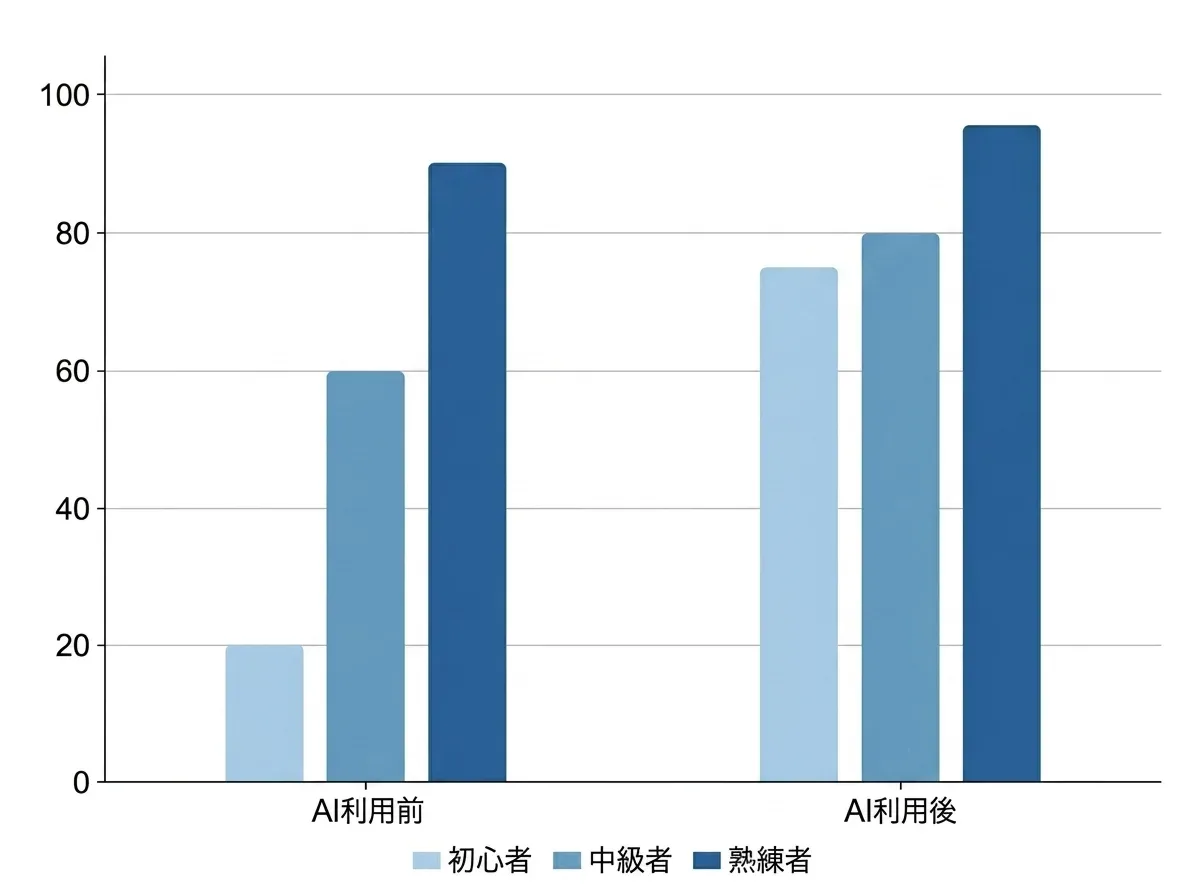
The conclusion first: AI narrows the 'apparent gap' between beginners and experts, but does not eliminate it. It is closer to reality to think of AI not as a technology that erases differences in ability, but as a technology that aggressively raises the minimum bar for deliverables.
[Image: A graph showing how the quality scores of beginners, intermediates, and experts change before and after the use of AI]
For example, suppose that in the past there was a spread: beginners at 20 points, intermediates at 60, and experts at 90. With AI, many people can now produce deliverables at around 70 to 80 points from the start. The beginner's minimum bar rises sharply, and at first glance the gap appears to have disappeared.
However, when it comes to raising quality from 80 to 90 or 95 points, accumulated experience and knowledge make a strong difference. Experts can judge 'what is wrong,' 'what should be fixed,' 'what to discard and what to keep,' and 'which option fits the goal.' This judgment is precisely the power needed to polish the 70 points AI has given you, all the way to the end, in line with your purpose.
Will the Skills You Have Honed All These Years Go to Waste?
This is one of the central questions of this article. The answer is: no, they will not. Just because AI can produce equivalent output does not mean the value of human-acquired skills drops to zero; where those skills are used changes.
What long-term effort yields is not just work speed. Failure experiences, pattern recognition, the ability to sense that something is off, quality standards, judgment criteria, your own tastes and aesthetic sense. These cannot be replaced by the surface of deliverables generated in a short time.
Sorting out the true nature of this conflict reveals a clash between two value systems. One is the belief that 'effort deserves value.' The other is the market logic that 'for the same result, the faster and cheaper one wins.' AI drives these two into intense collision. It is natural to feel pain from this collision, but the value of effort itself does not disappear. Going forward, the value of effort is highly likely to be recognized not as 'amount of work' but as 'accumulated judgment.'
The Value of Skill Shifts from 'the Ability to Create' to 'the Ability to Judge'

Connecting the arguments so far into a single line, it comes down to this: in the AI era, the value of technical skill shifts from 'the ability to create' to 'the ability to judge.'
[Image: A diagram showing the flow of technical value shifting from 'the ability to create' to 'the ability to judge']
Let's check with concrete examples. The more you know about art, the more accurately you can evaluate the broken composition and lighting of AI images. The more you know about music, the more easily you notice the off-ness of AI tracks. The better you understand programming, the more sharply you can spot the dangers of AI code. The longer you have been writing, the better you can judge the weaknesses and unnaturalness of AI writing.
In other words, past effort does not disappear. The value of the judgment accumulated through that effort comes to the forefront.
The More AI-Generated Content Grows, the More Valuable Firsthand Information and Real Experience Become
As AI mass-produces text, images, video, and music, the internet fills rapidly with 'plausible-looking information.' What becomes scarce in turn is information that humans have directly experienced. The more information AI mass-produces, the scarcer information that only humans can hold becomes.
The reason is simple. AI is extremely good at organizing and recombining existing information, but it cannot experience 'the facts the person actually experienced on the spot' on their behalf. Actually going to the location. Actually using the product. Actually interviewing the person. Actually building the system. Actually failing. Actually testing and comparing. Such firsthand information is, in principle, impossible for generative AI to create.
In media, publishing, and blogging, firsthand experience, unique data, original verification, interviews, original photographs, and personal stories of failure gain more value than articles that merely summarize information. The trend of trusting 'records from people who actually used and compared things' over 'roundup articles by unknown authors' is already strong, and this trend is likely to accelerate as generated content floods the field.
Provenance—'Who Made It, Why, and How'—Matters More Than 'AI-Made or Human-Made'
As technologies for detecting AI-generated content and watermarking spread, there will be more situations where we can determine 'was this made by AI or by a human?' But here we need to pause and think: is being AI-made, in itself, really the problem?
Suppose there is a truly great piece of music. If it was made by AI versus made by a human over six months, does the value for the listener necessarily change? The experience of listening to the track itself may be the same. On the other hand, information such as 'this person actually performed it,' 'this person actually went there,' 'this person experienced it firsthand,' 'this person made it with accountability,' and 'this person poured their life experience into this work' carries distinct value, separate from the quality of the track itself.
In other words, what matters may be not the simple binary of 'AI or human,' but the provenance and context: who made it, why, and how.
The spread of detection technology is likely to bring different changes to different industries. In media and publishing, the value of content that is merely well-presented declines, while interviewing, firsthand experience, and original verification grow in importance. In programming, auditing, reviewing, security checks, and accountability for black-box code mass-generated by AI become heavier burdens. In creative fields, polarization advances between fully automated generation and work that emphasizes human craftsmanship and context, and in the middle, the discerning eye and direction skills needed to curate AI output become important.
The Eight Elements That Will Become Scarce in the AI Era

What AI can mass-produce loses scarcity, and what AI cannot easily mass-produce gains value. To sum up, the eight elements that will become especially scarce going forward are: experience, firsthand information, personality, reputation and trust, responsibility, community, a discerning eye, and problem-setting ability.
[Image: A diagram giving an at-a-glance view of the eight elements that will become scarce in the AI era]
Below, we examine them in detail, divided into three groups by nature.
Information AI Cannot Mass-Produce: Experience and Firsthand Information
The first group is the scarcity of information itself. Experience—what the person actually did, failed at, and succeeded at—and firsthand information such as on-site reporting, original research, actual measurement, and experimentation. AI cannot 'experience' these, so the more generated content floods the market, the higher the relative value of these two becomes.
Relationships AI Cannot Take Over: Personality, Reputation, Responsibility, and Community
The second group is rooted in relationships between people. Personality—not just 'what is being said' but 'who is saying it.' Reputation and trust built through past achievements and consistent action. Being the entity that takes responsibility for final decisions and deliverables. And community—the connections with fans, customers, and colleagues. These are evaluated on axes separate from the quality of deliverables, making them hard for AI to replace.
Among these, 'responsibility' is especially important. AI can only guarantee the validity of its output at the level of likelihood, and it cannot become the entity that bears social responsibility for the consequences of adopting that output. Who signed off on the final decision? Those who can answer this question will be chosen as the ones to receive the work.
The Power to Choose and the Power to Pose Questions: A Discerning Eye and Problem-Setting Ability
The third group involves abilities related to selection. The discerning eye to pick what is truly good from countless candidates. And problem-setting ability to decide 'what to create' and 'what to solve.' The more AI improves its ability to produce answers, the more valuable it becomes to decide what questions to ask.
From 'Person Who Solves Problems' to 'Person Who Defines Problems'
In many jobs up to now, people who could skillfully solve given problems have been highly valued. But as AI strengthens problem-solving ability, the human role gradually moves upstream: not 'how to solve it,' but 'what should be solved in the first place.'
In programming, rather than writing code, what becomes important is the power to decide 'what to build,' 'whose problem, and what problem, to solve,' 'what specifications are needed,' 'what not to build,' and 'how much quality to demand.' If the direction of the specification is wrong, then no matter how fast AI writes code, all that happens is the wrong thing being produced fast. The work of verifying whether the definition of the problem to be solved is correct is a human domain that cannot be left to AI.
The same structure works in creative fields. Direction ability—what to have AI create, and which way to steer it. This is the practical form of the discerning eye and problem-setting ability mentioned in the previous section.
The Strongest Combination Is 'People with Skills Using AI'
You often see the phrase 'people who use AI will replace people who don't.' That aspect certainly exists. But what matters more is a different point: using AI itself will not become a long-term differentiator.
The reason is simple: AI is a tool that many people will come to use. 'Being able to use AI' alone will eventually become a prerequisite that everyone satisfies, leaving no gap. What is actually strong is people with specialized knowledge and experience using AI.
Expert engineer × AI, expert designer × AI, expert writer × AI, expert musician × AI. In these combinations, work speed increases thanks to AI, and because the experts themselves can evaluate and correct AI's output, quality is also easier to raise. In other words, AI does not render specialized skills worthless; it can become a tool that amplifies the productive capacity of those who possess such skills.
Conclusion: Skills Don't Disappear—Where Their Value Is Placed Changes
Let me restate the conclusion of this article. AI will not eliminate the value of technical skill. The place where that value is used changes.
Up to now, skills have been used 'to create with our own hands.' Going forward, they will also be used to evaluate AI's output, spot errors, pick out the good, set direction, and guarantee final quality. In a world where anyone can produce deliverables above a certain level, differences in sheer work capability become hard to see. What matters then is the judgment cultivated through years of experience. Skills will not disappear. The value of skill shifts from 'the power to create' to 'the power to judge.'
If you already use AI, try paying attention to how you can apply your skills to verifying and improving its output. If you are just starting to learn a skill, think about how to accumulate experience in telling good from bad, not just in reproducing the work. To sum it up in one sentence: AI does not make human skills unnecessary; it transforms skills from 'the power to create' into 'the power to judge correctly.'