
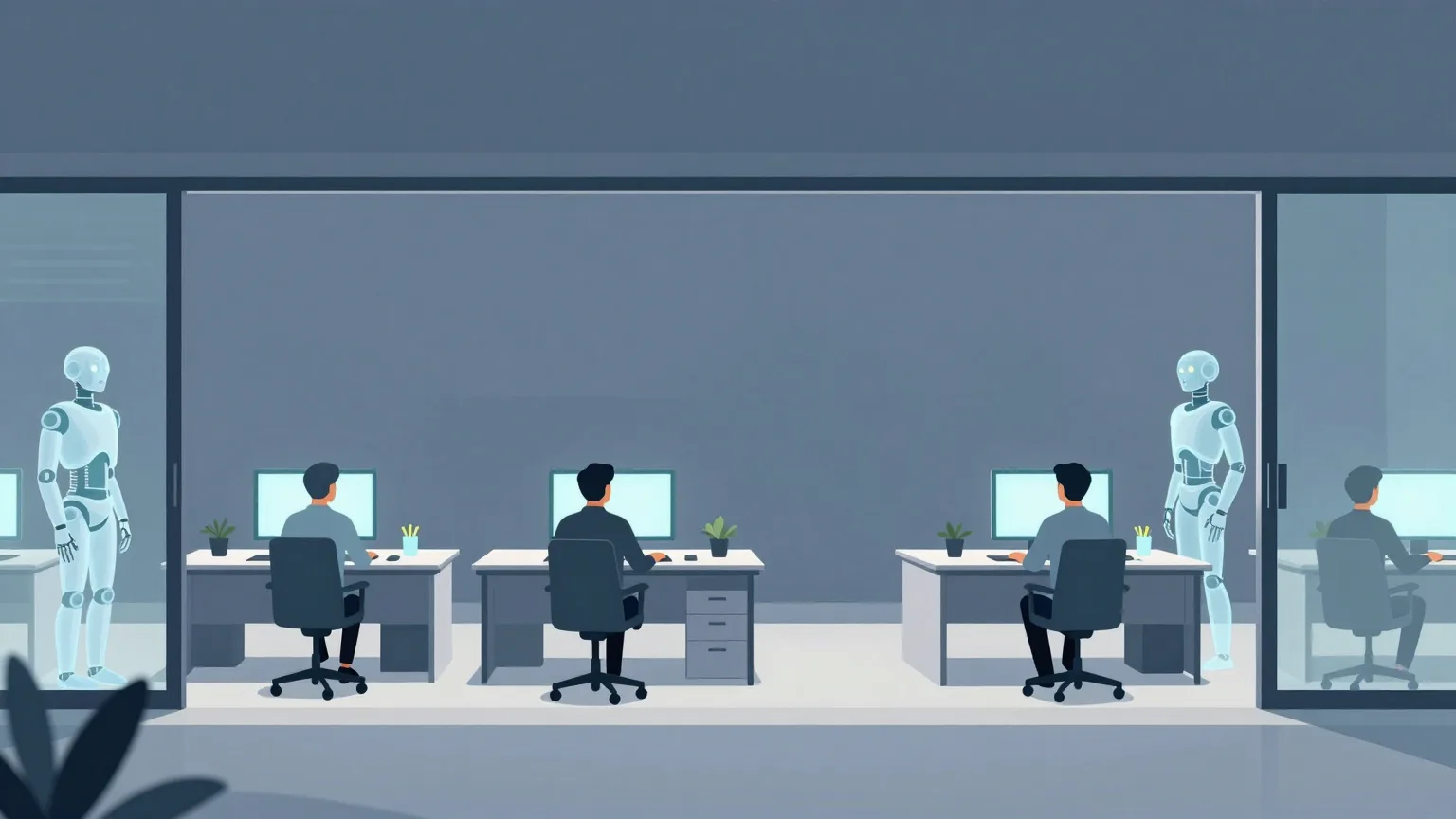
Tonight's roundup captured two opposing currents in a single day: the reality of enterprise AI, and the forward march of robotics AI. Meta's AI layoff plan fell apart, and a survey found that 90% of executives have yet to feel any productivity gains from AI. Meanwhile, embodied AI foundation models are steadily entering the scaling phase.
Meta Withdraws Its Plan for Large-Scale AI Layoffs — Amid Employee Backlash and Agent Failures
According to Reuters reporting covered by The Decoder, Meta had been pursuing a plan to replace considerably more employees with AI than was publicly known. The plan ultimately collapsed and was shelved in the face of fierce internal pushback and AI agents that failed to deliver the hoped-for results.
What makes the story notable is that the plan failed for two distinct reasons at once. The first is organizational resistance. The second is a technical limitation: autonomous AI agents still cannot produce the expected results in actual day-to-day work. As a concrete case of the "cut headcount with AI" scenario running into the organizational and technical walls of reality sooner than leadership anticipated, the report could well weigh on decisions at other major companies.
90% of Executives Say AI Has Not Improved Productivity — A Fortune Survey
Equally striking the same day was a survey reported by Fortune: 90% of executives answered that AI has not improved their productivity.
Read together with the Meta story, the finding is telling. Adoption may be spreading, but the executives who actually feel the benefits are still a minority. With AI investment continuing to balloon, how — or whether — the gap between expectations and lived reality on the ground gets closed will be one of the key questions in gauging where enterprise AI goes from here.
GigaBrain-0.7 — An Embodied Model Unifying Understanding, Prediction, and Action in a Three-System Architecture
On the technical front, meanwhile, a major research result in embodied AI went public. Released as a paper posting on Hugging Face, GigaBrain-0.7 is an embodied foundation model that generalizes across diverse robot bodies, and it comes with the following features:
It adopts a three-system architecture that unifies understanding, prediction, and action within a single model, bringing a world model into the real-time decision-making loop to realize a "simulate and evaluate before acting" mechanism (System-3)
Pretrained on more than 37,000 hours of heterogeneous real-robot data, it introduces a one-stage alignment training that jointly optimizes vision-language understanding and action generation across multiple robot bodies
It achieves zero-shot capability and instruction-following that significantly outperform prior state-of-the-art models such as π0.5
On the company's own robot, the Maker H01, it delivered an industry-first demo completing long-horizon precision work — more than 10 tasks and over 20 minutes — in a single continuous take
TechCrunch, also that day, reported under the headline "The developers of robot brains are leaving the GPT-2 era behind" that the long-standing situation of robot bodies waiting for AI brains to mature has started to change. The move reads as robotics AI stepping onto the same "scaling curve" that LLMs climbed a few years ago.
The Next Challenge for CX Is "Orchestration" — The Limits of Bolting AI Onto Legacy Systems
An opinion piece on VentureBeat argues that the next challenge for AI adoption in enterprise customer experience (CX) lies in orchestration.
Having "bolted on" conversational and voice AI to legacy systems that were never designed for it, many companies are left with systems that do not talk to each other, forcing human operators to shoulder the heavy cognitive load of rebuilding customer context across disconnected tools. The real problem, the piece argues, is not access to data but the absence of a "shared context layer" that would cut across customer information, history, transactions, and policies.
"Automation solves individual tasks; orchestration turns them into end-to-end outcomes." The argument that as agents multiply, competitive advantage comes less from adding intelligence than from coordinating the intelligence you already have seems applicable to enterprise AI at large — not just CX.
Voices From Japan — "Designing Verification" and "Reducing Task Freedom"
Japan's developer community also saw a run of articles grappling with the quality of AI coding.
A Qiita post titled "The bottleneck of AI coding is no longer implementation — what's needed next is the design of verification" poses the question: when AI writes the implementation, AI writes the tests, AI passes those tests, and AI itself finally declares "all clear," can that structure be accepted as quality assurance? The argument that the next bottleneck is breaking, through design, the fragility of generation and verification being closed inside the same agent also echoes the reports of Meta's agent failures.
Another Qiita piece, "Reduce a task's degrees of freedom before raising effort," points out that handing a model more capability or higher reasoning effort can actually degrade output quality. Excessive reasoning invents premises the instructions never contained and breeds needless complexity — the practical lesson of narrowing the task first and only then unleashing the model's power looks like a useful hint for running AI effectively.
Other Developments
Amazon's AI training data warehouses** — 404 Media, an investigative news outlet, reported from inside "the Amazon warehouses that scan and destroy books for AI training." Notable as reporting on how books, as copyrighted works, are being consumed as raw material for AI development
MiniMax revenue nearly quadruples** — According to Reuters, China's MiniMax saw first-half revenue grow roughly fourfold on expanding AI demand
"AI" now appears in 14.4% of Hacker News titles** — An analysis tool released on Show HN found that the share of new HN titles containing the word "AI" has reached 14.4% this year (up from 10.9% in 2025). The Show HN category is the highest, at 19.8%
Invisible watermarks come to Microsoft Paint and Photos** — According to Tom's Hardware, Microsoft is adding invisible watermarks (GUID embedding) to AI-generated content, and developers have reverse-engineered how the mechanism works