
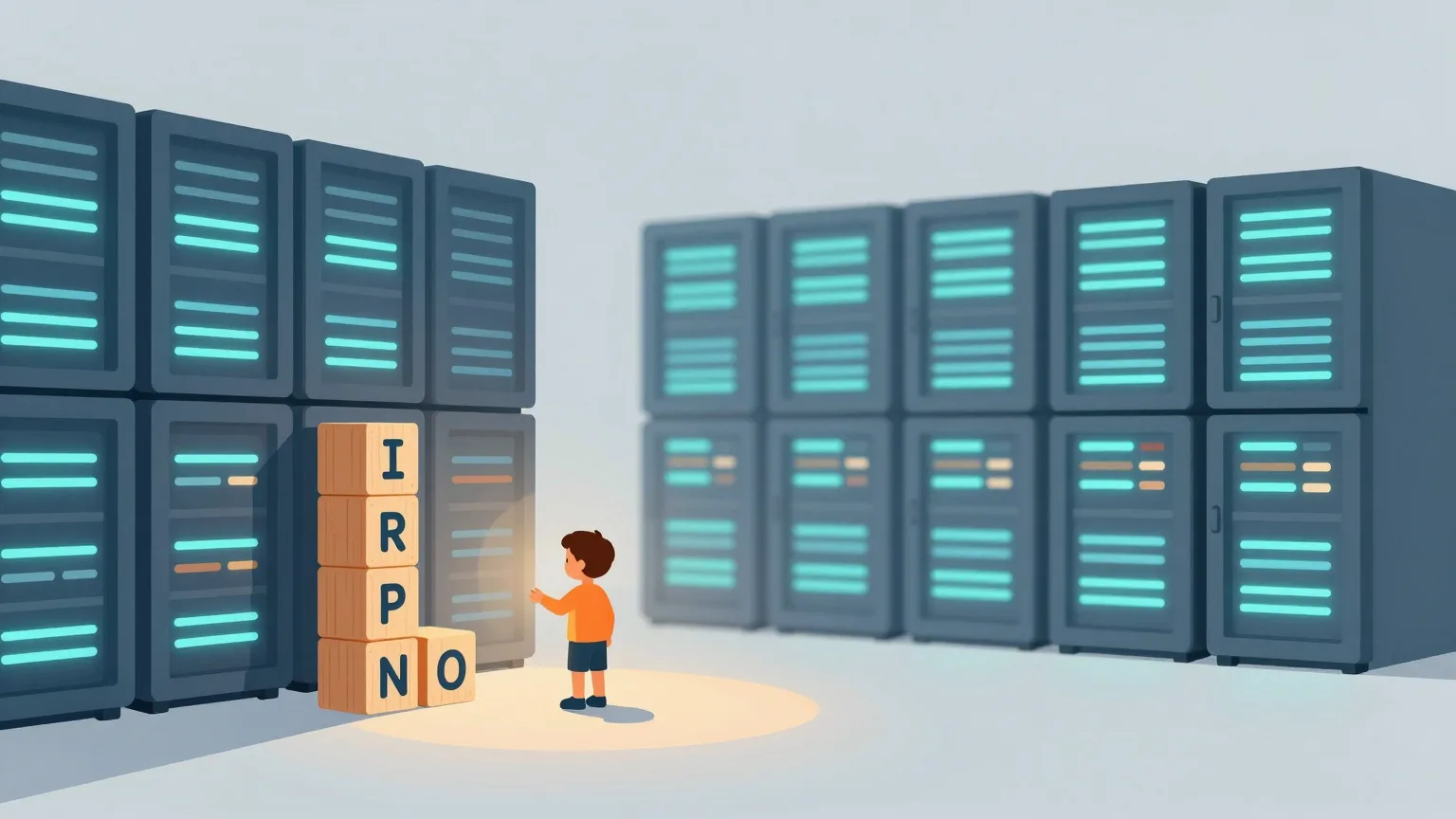
Children acquire language from far less data than state-of-the-art LLMs. That gap is called the "data efficiency gap." MIT Technology Review recently ran a long-form article detailing how cognitive science and AI research are converging around this divide. On the industry side, Meta, NVIDIA, and Alibaba have released 30B-class open models one after another, and Japanese media have been pondering "why they're so hot right now." On the investment front, Nvidia was reported to be in talks to invest in Perplexity at a valuation exceeding $30 billion.
Why Can Children Learn Language from Less Data Than AI?
It has been four years since ChatGPT arrived. LLMs now speak as fluently as humans, but behind the scenes they consume more than 100,000 times the words a person is exposed to while acquiring their native language. The MIT Technology Review article carefully traces the current state of research on this "data efficiency gap."
The article argues that the scale of the difference can only be conveyed through metaphor. If you printed the training words of a modern LLM on paper, the stack would rise higher than the International Space Station. By contrast, the roughly 100 million words an 11-year-old human hears would, stacked, reach only about 20 meters. Meta's Llama 3.1 consumed 15 trillion tokens in pretraining, and frontier models are believed to reach ten times that. That said, the well of easily obtainable data could run dry as early as the 2030s.
Children are a different story. Toddlers begin speaking grammatically correct sentences after hearing roughly 10 million words (30 million for some). In the words of Stanford cognitive scientist Michael C. Frank, "If you train GPT-2 on 30 million words, what you get is a nonsense generator, not a child."
An annual competition called BabyLM aims to close this gap. Models are trained on "developmentally plausible" corpora of 100 million words (the infant-scale track uses 10 million) and evaluated on the same grammar benchmarks used for humans. Curriculum learning—progressing stage by stage from simple to complex data—was the most popular approach in the first edition, but it has turned out to be less effective than expected. Meanwhile, the 2024 winning model, GPT-BERT, combined next-token prediction with cloze completion (masked language modeling) and, with only about 100 million words of pretraining, beat Llama 2 70B—trained on roughly 15,000 times more data—on one benchmark.
But while BabyLM models are "babies" in size, the way they learn is not baby-like. Children take in the world through sight and sound, not a text-only program. Headcam research records that "world as children see it": SAYCam, released by Stanford's Frank and colleagues, filmed the lives of three children for two hours a week, from 6 months to two and a half years of age. A team led by Princeton's Brenden Lake reported in 2024 that a model trained on nothing but those 61 hours of raw video could link objects in the footage with words—without the innate biases long thought necessary for language acquisition. Going further, Princeton's Uri Hasson recently published a preprint describing a large-scale dataset recording the first 1,000 days of 17 children, 12 hours a day, using cameras and microphones throughout their homes.
The missing pieces may be "active exploration" and "sociality," the article argues in its latter half. Children don't passively watch the world; they experiment and deliberately set out to fill in what they don't know. Developmental psychologist Alison Gopnik believes the next generation of AI—whatever comes after transformers—will be the one that learns from developmental psychology. Beyond practical motivations like building models for low-resource languages and enabling labs without massive compute to train models, closing the data efficiency gap also leads to "understanding ourselves," the article concludes.
Why 30B-Class Open Models Are So Hot Right Now
ITmedia AI+ published an article examining "why the field is heating up now," covering the current landscape in which Meta, NVIDIA, and Alibaba have successively released 30B-class open models and Japan's own LLM-jp-4 33B has also arrived. The article also reports the emergence of a model claiming to "beat Opus 4.6 with 27B parameters."
A Reddit post backing up the impressions of those running these models locally also appeared. A user ran the Aider benchmark on Qwen 3.8 27B FP8 (FP8 KV cache, 256K context, vLLM) and measured a score of 72.9—tying Gemini 2.5 Pro from April 2025 (72.9) and beating Claude Opus 4 from May 2025 (72.0) and DeepSeek R1 from June 2025 (71.4). While the poster caveated that it's "just one of the old benchmarks," they reflected on how remarkable it is that a Mac can now put up SOTA-class scores from a little over a year ago.
Qwen 3.8 27B has repeatedly made news as a divisive model, and on the same day a thread asking "what is it bad at?" also appeared—suggesting that real-world validation by practitioners is still underway.
Nvidia in Talks to Invest in Perplexity at a Valuation Over $30 Billion
The Decoder, citing a report by The Information, reported that Nvidia is in talks to invest in Perplexity AI at a valuation exceeding $30 billion. The valuation would be more than 50% above the previous funding round. Perplexity's annualized revenue has tripled to over $750 million.
The article also touches on the pattern in which Nvidia's investment money tends to flow back as revenue when portfolio companies purchase its chips. If the deal goes through, capital ties between the AI infrastructure side and the application side will deepen further. Talks are ongoing at this point, and the terms and likelihood of completion are unknown.
Anthropic: "Australia Lags the World in Coding Use of Claude"
Theo Hourmouzis, Anthropic's head of Australia and New Zealand, spoke about the characteristics of Claude usage in Australia at a company event (via Bloomberg). According to him, while coding use of Claude in Australia lags the global customer average, "practical back-office tasks" such as invoice processing, inventory management, and general administration account for 5.8% of usage—above the global average of about 4.7%.
"Australian usage leans too heavily on back-office work," he said. It's a fascinating piece of data showing how the center of gravity of usage shifts by country, even with the same model.
Teachers, Not Just Students, Targeted as Deepfake Harm Spreads Through Schools
Deepfake harm in schools is not only a problem for students. WIRED compiled testimonies from four teachers who were targeted with sexual AI-generated content. Beyond the harm itself, the difficulty of finding anyone to hold accountable makes recovery even harder. The piece shows that, as generative AI spreads, putting response measures in place at schools is an urgent task.
UniSpace: Unifying "Understanding" and "Generation" in One Visual Representation with a Frozen ViT
One paper drawing attention on Hugging Face's Daily Papers is UniSpace. The approach reparameterizes the patch embeddings of a pretrained ViT to unify semantic understanding and reconstruction/generation in a single visual representation. Rather than adding separate encoders for semantics and reconstruction, it introduces a reconstruction-aware pathway while preserving the original semantic pathway. The key insight: the frozen ViT blocks already contain rich visual information, and the bottleneck lies in the parameterization of the input tokens. It is positioned as a step toward a unified visual representation for multimodal models.
Developer News from Japan: Watch Out for the "httpx Departure" in anthropic SDK 1.0.0
A number of hands-on AI coding articles from Japanese developers were also published. One highlight explains that when the anthropic Python SDK reached 1.0.0, its HTTP layer was migrated from httpx (whose maintenance is said to be no longer active) to another library. Because things keep working as-is after the migration, the change is easy to miss.
Other published field notes include an attempt to separate requirements, implementation, review, and verification for AI coding agents on an OpenSpec basis; a design practice for an autonomous agent that asynchronizes article generation via a job queue; and the building of a deliberation mechanism in which multiple AIs vote independently rather than relying on a single AI's judgment.